


Share This Article:
Summer Safety Series
Welcome to The Science Behind Workplace Injuries: 30 Days of Summer Safety, where we explore the environmental hazards, human physiology, behavioral science, and organizational decisions shaping workplace safety. This article is part of our July series examining the science behind workplace injuries and the factors influencing workplace safety during the summer months.
Transportation is changing faster than many workplace safety programs. Electric bicycles, scooters, and other micromobility devices have become common on college campuses, city streets, corporate campuses, warehouses, and delivery routes. These transportation modalities offer an efficient way to move people and goods through increasingly crowded environments. They also introduce risks that many organizations have not fully recognized.
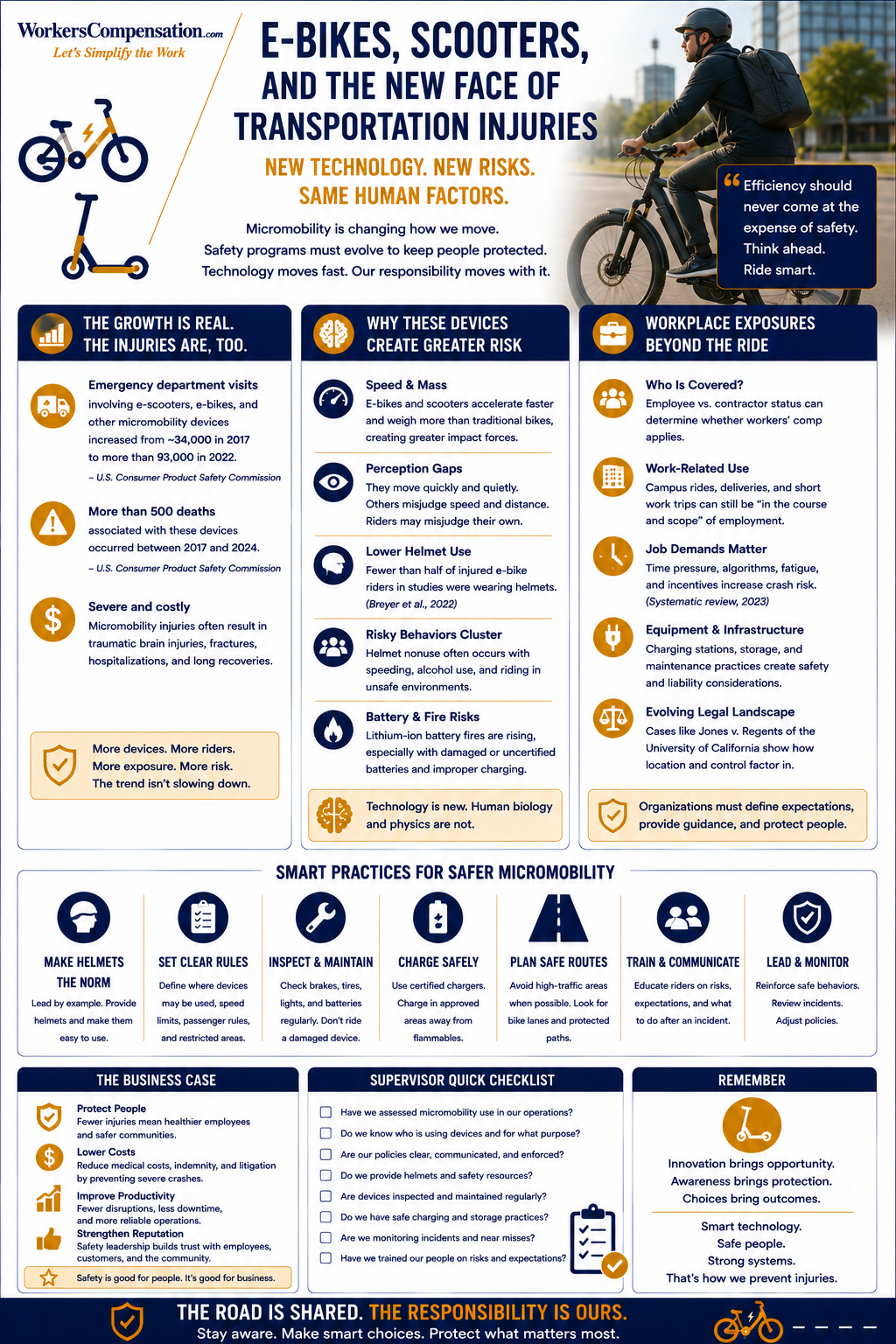
The numbers illustrate how quickly this shift is occurring. According to the U.S. Consumer Product Safety Commission, emergency department visits involving e-scooters, e-bikes, and other micromobility devices increased from approximately 34,000 in 2017 to more than 93,000 in 2022. Fatalities have also continued rising, with the Commission identifying more than 500 deaths associated with these devices between 2017 and 2024. Growth in micromobility has been remarkable. Safety practices have struggled to keep pace.
At first glance, an e-bike appears similar to a traditional bicycle. Trauma research suggests otherwise as Fernandez and colleagues, writing in JAMA Network Open, found injuries involving electric bicycles have increased dramatically in recent years and are generally more severe than injuries involving conventional bicycles. Multiple trauma-center studies report higher rates of traumatic brain injuries, intracranial hemorrhage, facial fractures, hospital admissions, and intensive care admissions among e-bike riders. The difference is not simply the bicycle. It is the combination of greater speed, greater mass, and greater impact energy.
Human perception has not evolved as quickly as transportation technology. The brain estimates speed, distance, and closing rates using experience developed over thousands of everyday observations. Electric bicycles and scooters accelerate more rapidly and move more quietly than traditional bicycles, creating situations where pedestrians, motorists, and even riders themselves misjudge available time and space. The technology is new. The neuroscience is not. Our brains continue relying on the same perceptual systems they have always used to navigate the world.
Behavior also plays an important role. Breyer and colleagues reported fewer than half of injured e-bike riders involved in their study were wearing helmets, despite overwhelming evidence that helmets reduce the risk of serious head injury. Researchers also found helmet nonuse frequently clustered with other risk-taking behaviors including excessive speed, alcohol use, and riding in environments not designed for these devices. The challenge extends beyond knowledge. It reflects how people perceive risk and make decisions in rapidly changing environments.
Another emerging concern involves the workplace itself. Delivery drivers, campus employees, healthcare workers, warehouse personnel, and other mobile employees increasingly rely on micromobility devices during the workday. In many organizations, safety programs were originally developed around passenger vehicles or traditional bicycles. Micromobility introduces new questions involving employee classification, equipment standards, route planning, battery safety, charging practices, and organizational responsibility that many employers are only beginning to address.
The workplace exposure extends beyond the ride itself. Researchers studying last-mile delivery services have identified a combination of time pressure, algorithmic management, fatigue, distraction, and economic incentives that encourage riders to take greater risks. A systematic review examining more than 38,000 delivery workers found these job demands were consistently associated with higher levels of stress, fatigue, burnout, and crash risk. Technology may determine the route. Human biology continues determining performance.
Another emerging hazard has to do with energy storage. Lithium-ion battery fires associated with damaged or uncertified batteries have increased in recent years, particularly among heavily used delivery e-bikes. Unlike many conventional fires, lithium-ion batteries can enter thermal runaway, producing intense heat, toxic smoke, and fires that spread rapidly. This risk extends beyond riders to employers responsible for charging stations, storage areas, and building safety. Transportation technology now carries an important property and life safety consideration as well.
Workers' compensation professionals are navigating new legal and operational questions. Some injuries involve traditional employees riding employer-provided devices on corporate campuses or during work activities. Others involve app-based delivery drivers whose employment status may determine whether workers' compensation coverage applies at all. Court decisions, including Jones v. Regents of the University of California, demonstrate how compensability may depend on factors such as employer control, location, and whether the injury occurred within the course and scope of employment. As transportation evolves, the legal landscape continues evolving alongside it.
Federal safety guidance specific to micromobility remains limited. OSHA and NIOSH have well-established recommendations for motor vehicle safety, distracted driving, fatigue management, and personal protective equipment, although no comprehensive federal standard currently exists for workplace e-bike or e-scooter programs. That gap creates an opportunity for organizations to lead rather than wait. Employers can adapt proven safety principles by requiring UL-certified equipment, establishing safe charging practices, implementing helmet policies, providing device-specific training, and designing routes and schedules that reduce unnecessary time pressure.
The same human performance principles we have explored throughout this series continue to apply. Riders experience fatigue. Heat influences cognitive performance. Stress affects decision-making. Optimism bias changes risk perception. Situational awareness determines whether a pedestrian, vehicle, or roadway hazard is recognized in time to respond. New technology has introduced new devices. It has not changed the way the human brain processes information.
Workplace safety evolves alongside the way people work and as a result, organizations need to understand innovation. The most effective safety programs recognize every new technology brings new opportunities, new responsibilities, and new ways for human performance to interact with the environment. Technology will continue advancing. The science of human behavior remains one of the strongest tools organizations have for ensuring those advances improve both productivity and safety.
Tomorrow in The Science Behind Workplace Injuries - Why Experienced Workers Still Fall. Falls remain one of the leading causes of serious workplace injuries, and many involve employees with years of experience. Tomorrow, we examine how balance, perception, muscle function, attention, and familiarity combine to influence one of the oldest hazards in the workplace.


AI best practices california case file caselaw case management case management focus claims compensability compliance compliance corner courts do you know the rule employers exclusive remedy florida fraud glossary check Healthcare hr homeroom insurance insurers iowa kentucky leadership NCCI new jersey new york ohio pennsylvania Safety safety at work state info tech technology the case manager violence WDYT what do you think women's history women's history month workers' comp 101 workers' recovery Workplace Safety Workplace Violence
Read Also
About The Author
About The Author
-
Claire Muselman
Meet Dr. Claire C. Muselman, the Chief Operating Officer at WorkersCompensation.com, where she blends her vast academic insight and professional innovation with a uniquely positive energy. As the President of DCM, Dr. Muselman is renowned for her dynamic approach that reshapes and energizes the workers' compensation industry. Dr. Muselman's academic credentials are as remarkable as her professional achievements. Holding a Doctor of Education in Organizational Leadership from Grand Canyon University, she specializes in employee engagement, human behavior, and the science of leadership. Her diverse background in educational leadership, public policy, political science, and dance epitomizes a multifaceted approach to leadership and learning. At Drake University, Dr. Muselman excels as an Assistant Professor of Practice and Co-Director of the Master of Science in Leadership Program. Her passion for teaching and commitment to innovative pedagogy demonstrate her dedication to cultivating future leaders in management, leadership, and business strategy. In the industry, Dr. Muselman actively contributes as an Ambassador for the Alliance of Women in Workers’ Compensation and plays key roles in organizations such as Kids Chance of Iowa, WorkCompBlitz, and the Claims and Litigation Management Alliance, underscoring her leadership and advocacy in workers’ compensation. A highly sought-after speaker, Dr. Muselman inspires professionals with her engaging talks on leadership, self-development, and risk management. Her philosophy of empathetic and emotionally intelligent leadership is at the heart of her message, encouraging innovation and progressive change in the industry. "Empowerment is key to progress. By nurturing today's professionals with empathy and intelligence, we're crafting tomorrow's leaders." - Dr. Claire C. Muselman
More by This Author
Read More
- Oct 14, 2026
- Claire Muselman
- Oct 14, 2026
- Frank Ferreri
- Oct 13, 2026
- Claire Muselman
- Oct 13, 2026
- Frank Ferreri
- Oct 12, 2026
- Claire Muselman
- Oct 12, 2026
- Anne Llewellyn