


Share This Article:
The Human Side of Alignment
Article 6 of 8
A return-to-work plan is nearly complete when an adjuster notices a problem. The employer's proposed duties include lifting that appears inconsistent with the injured worker's current restrictions. The employer wants a start date, and the department is behind on files. The claims supervisor could press for an immediate answer and move the file along. Instead, the supervisor backs the request for clarification and explains the delay at the next review.
No dramatic speech follows the decision. The adjuster knows the supervisor will support reasonable escalation. Colleagues watching the exchange learn something about how the department operates under pressure. The supervisor's decision provides evidence of the priorities employees have heard described in meetings. Leadership credibility grows when stated commitments survive difficult choices.
Credibility Is Something Employees Observe
Organizational researcher Tony Simons uses the term behavioral integrity to describe the perceived alignment between a leader's words and actions. A 2015 meta-analysis linked behavioral integrity to employee trust, commitment and performance. The research distinguished word–deed alignment from judgments of a leader's morality. Professionals are watching whether promises are kept and whether values hold across different circumstances. Leadership messages become useful when employees can predict behavior.
A 2022 review by Simons, Hannes Leroy and Lisa Nishii adds an important qualification. Behavioral integrity depends on observers, whose perceptions can differ. An unpopular decision does not automatically make a supervisor inconsistent. Employees may understand a difficult outcome when leaders explain the tradeoffs. Leaders need feedback about how their choices are interpreted rather than assuming good intentions will speak for themselves.
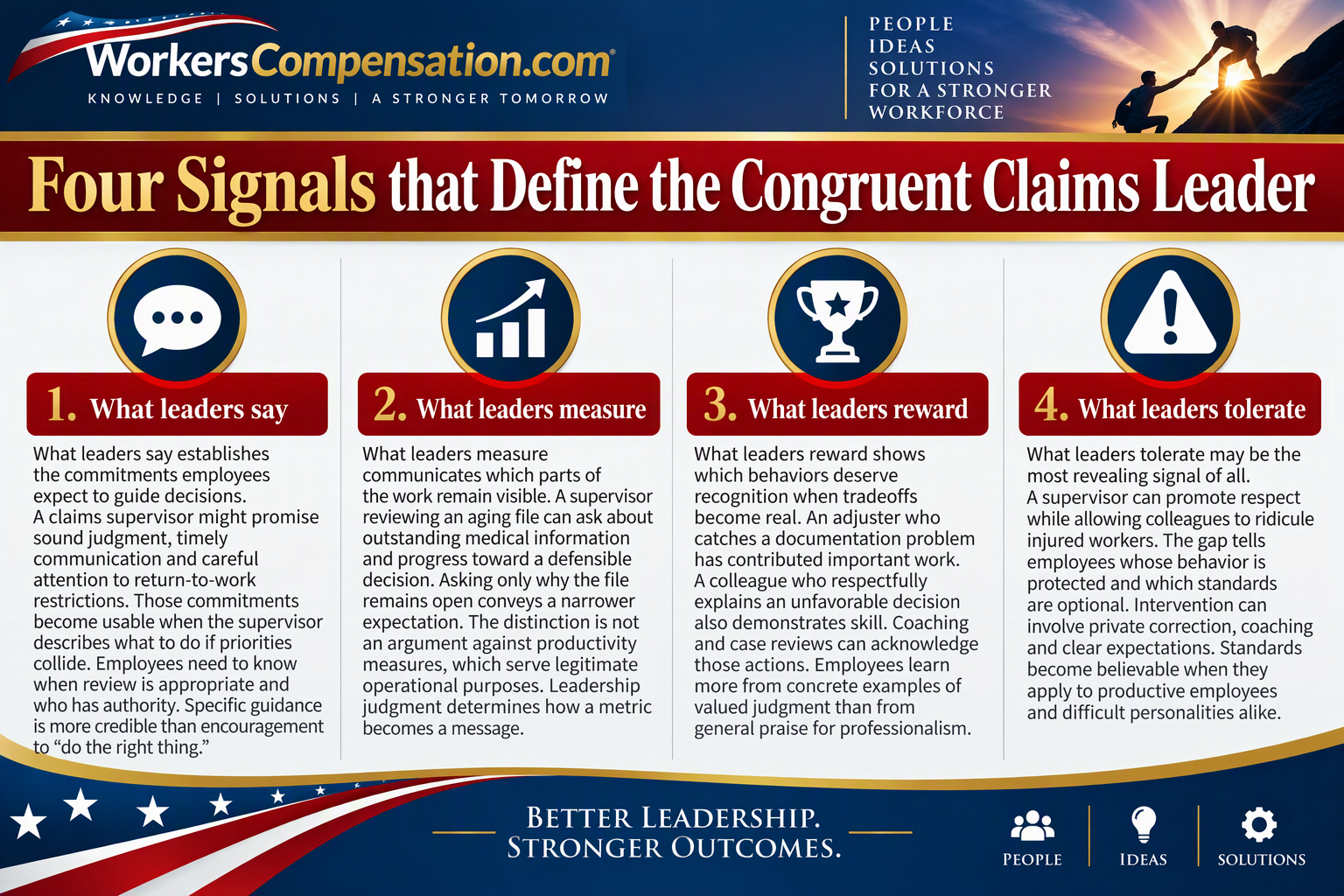
Four Signals that Define the Leader
What leaders say establishes the commitments employees expect to guide decisions. A claims supervisor might promise sound judgment, timely communication and careful attention to return-to-work restrictions. Those commitments become usable when the supervisor describes what to do if priorities collide. Employees need to know when review is appropriate and who has authority. Specific guidance is more credible than encouragement to “do the right thing.”
What leaders measure communicates which parts of the work remain visible. A supervisor reviewing an aging file can ask about outstanding medical information and progress toward a defensible decision. Asking only why the file remains open conveys a narrower expectation. The distinction is not an argument against productivity measures, which serve legitimate operational purposes. Leadership judgment determines how a metric becomes a message.
What leaders reward shows which behaviors deserve recognition when tradeoffs become real. An adjuster who catches a documentation problem has contributed important work. A colleague who respectfully explains an unfavorable decision also demonstrates skill. Coaching and case reviews can acknowledge those actions. Employees learn more from concrete examples of valued judgment than from general praise for professionalism.
What leaders tolerate may be the most revealing signal of all. A supervisor can promote respect while allowing colleagues to ridicule injured workers. The gap tells employees whose behavior is protected and which standards are optional. Intervention can involve private correction, coaching and clear expectations. Standards become believable when they apply to productive employees and difficult personalities alike.
Commitment to the Return-to-Work Process
Research on return to work offers a practical connection between leadership and frontline action. The Institute for Work & Health identifies visible commitment to health and safety, supervisor involvement and early considerate contact among seven evidence-informed principles for successful return to work. The guidance emphasizes planning suitable work and coordinating responsibilities. Commitment is expressed through resources, preparation and follow-through. The principles address workplace practices broadly rather than validating a specific claims-leadership model.
A 2006 controlled case study by William Shaw and colleagues offers a useful example with important limits. Eleven supervisors at a food-processing plant received training in communication and workplace accommodation, while twelve served as delayed-training controls. In the seven months following training, new claims declined 47% in the intervention group and 27% in the control group. The small single-plant study cannot establish results elsewhere. The findings justify examining supervisor behavior as part of claims operations.
Testing Leadership Standards
Claims leaders can begin by inviting employees to describe the last time a supervisor's response either reinforced or complicated an organizational promise. Ask about decisions involving incomplete information, disputed restrictions, difficult conversations and competing deadlines. Compare examples with the guidance supervisors believe they provide. Identify where employees need clearer authority, coaching or second opinions. The exercise gives leaders an opportunity to improve consistency before asking teams to trust another values statement.
An additional question belongs in every leadership review: Which behavior have we quietly allowed because the person producing it performs well? High output does not excuse dismissive communication, avoidance of necessary escalations or unreliable follow-through. Leaders can apply consistent expectations while respecting case complexity. Employees benefit from understanding how a supervisor will respond when a principled action complicates a short-term target. Credibility becomes stronger when accountability includes the leader's own choices.
The Congruency Effect proposes that alignment inside a claims organization may influence the experience of the injured worker through the people managing the claim. Research supports important parts of the proposed pathway, including connections between leader behavioral integrity and employee attitudes. The complete pathway to claim outcomes remains untested. Leaders can examine consistency without waiting for a study. Their responsibility is to make the standards they communicate visible in the work they support, recognize and permit.
Research Referenced
Institute for Work & Health. (2007, revised 2014). Seven "Principles" for Successful Return to Work.https://www.iwh.on.ca/tools-and-guides/seven-principles-for-successful-return-to-work
Shaw, W. S., Robertson, M. M., McLellan, R. K., Verma, S., & Pransky, G. (2006). A controlled case study of supervisor training to optimize response to injury in the food processing industry. Work, 26(2), 107–114. https://doi.org/10.3233/WOR-2006-00498
Simons, T., Leroy, H., Collewaert, V., & Masschelein, S. (2015). How leader alignment of words and deeds affects followers: A meta-analysis of behavioral integrity research. Journal of Business Ethics, 132, 831–844. https://doi.org/10.1007/s10551-014-2332-3
Simons, T., Leroy, H., & Nishii, L. (2022). Revisiting behavioral integrity: Progress and new directions after 20 years. Annual Review of Organizational Psychology and Organizational Behavior, 9, 365–389. https://doi.org/10.1146/annurev-orgpsych-012420-062016


AI best practices california case file caselaw case management case management focus claims compensability compliance compliance corner courts do you know the rule employers exclusive remedy florida fraud glossary check Healthcare hr homeroom insurance insurers iowa kentucky leadership NCCI new jersey new york ohio pennsylvania Safety safety at work state info tech technology the case manager violence WDYT what do you think women's history women's history month workers' comp 101 workers' recovery Workplace Safety Workplace Violence
Read Also
- Nov 15, 2026
- Chris Parker
- Nov 15, 2026
- Claire Muselman
About The Author
About The Author
-
Claire Muselman
Meet Dr. Claire C. Muselman, the Chief Operating Officer at WorkersCompensation.com, where she blends her vast academic insight and professional innovation with a uniquely positive energy. As the President of DCM, Dr. Muselman is renowned for her dynamic approach that reshapes and energizes the workers' compensation industry. Dr. Muselman's academic credentials are as remarkable as her professional achievements. Holding a Doctor of Education in Organizational Leadership from Grand Canyon University, she specializes in employee engagement, human behavior, and the science of leadership. Her diverse background in educational leadership, public policy, political science, and dance epitomizes a multifaceted approach to leadership and learning. At Drake University, Dr. Muselman excels as an Assistant Professor of Practice and Co-Director of the Master of Science in Leadership Program. Her passion for teaching and commitment to innovative pedagogy demonstrate her dedication to cultivating future leaders in management, leadership, and business strategy. In the industry, Dr. Muselman actively contributes as an Ambassador for the Alliance of Women in Workers’ Compensation and plays key roles in organizations such as Kids Chance of Iowa, WorkCompBlitz, and the Claims and Litigation Management Alliance, underscoring her leadership and advocacy in workers’ compensation. A highly sought-after speaker, Dr. Muselman inspires professionals with her engaging talks on leadership, self-development, and risk management. Her philosophy of empathetic and emotionally intelligent leadership is at the heart of her message, encouraging innovation and progressive change in the industry. "Empowerment is key to progress. By nurturing today's professionals with empathy and intelligence, we're crafting tomorrow's leaders." - Dr. Claire C. Muselman
More by This Author
- Nov 15, 2026
- Claire Muselman
- Nov 13, 2026
- Claire Muselman
Read More
- Nov 15, 2026
- Chris Parker
- Nov 15, 2026
- Claire Muselman
- Nov 13, 2026
- Claire Muselman
- Nov 13, 2026
- Frank Ferreri
- Nov 13, 2026
- Claire Muselman