


Share This Article:
Fall Into Safety
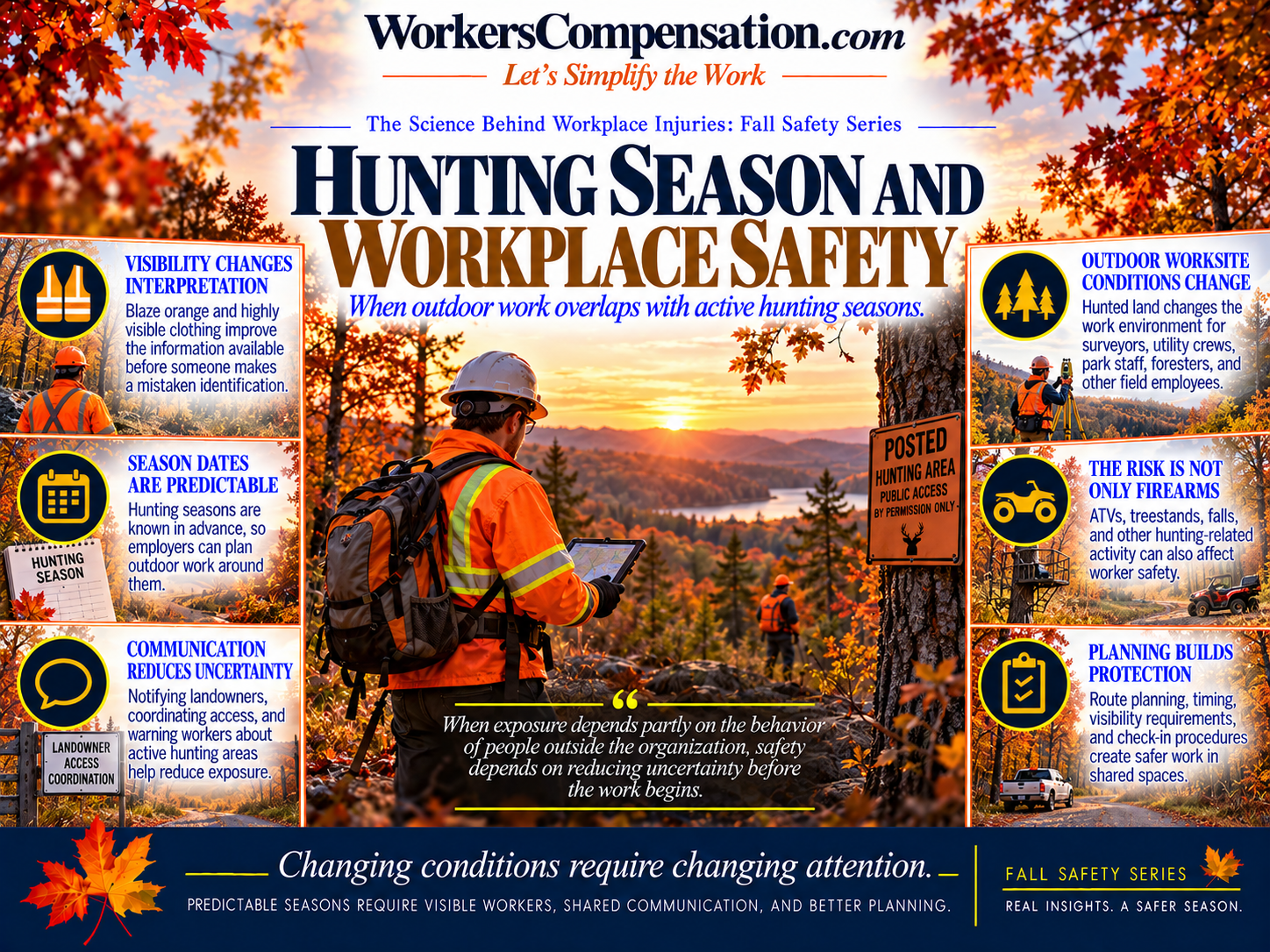
Welcome to The Science Behind Workplace Injuries: Fall Safety Series, where we explore how seasonal conditions interact with human physiology, behavior, and workplace systems. Yesterday, we examined deer collisions and the overlap between animal behavior, darkness, and occupational driving. Today, hunting season adds another kind of overlap. Foresters, utility and pipeline crews, surveyors, agricultural workers, park employees, wildlife professionals, meter readers, and other outdoor workers may enter areas where hunting is occurring. We do not have reliable national data telling us how often workers are shot by hunters while performing their jobs, and the available evidence suggests these incidents are rare. Low frequency, however, does not eliminate the need to manage a foreseeable high-severity exposure.
Visibility Changes What the Brain Has to Interpret
Hunter orange exists for a simple reason: human vision performs better when a person is visually distinct from the surrounding environment. A CDC analysis of hunting-associated firearm injuries in New York from 1989 through 1995 examined 125 incidents in which someone was mistaken for game. Among those injured, 117, or 94%, were not wearing hunter orange. The study was observational, so those numbers cannot tell us how much orange independently reduced risk. They do demonstrate how frequently poor conspicuity appeared in incidents where one person incorrectly identified another.
The science becomes more interesting when we consider how identification errors occur. Karl Bridges, Paul Corballis, and Erik Hollnagel examined mistaken-for-game incidents through a human-factors lens and found that target identification develops through interacting conditions involving perception, expectations, experience, environment, and decision-making. A hunter scanning vegetation for a deer is actively searching for a particular pattern. Under ambiguous conditions, movement, shape, color, and expectation can combine into a confident interpretation before enough information exists to verify it. Later experimental work by Bridges and Corballis found direct peer pressure shortened the time participants took to make simulated shooting decisions. The workplace lesson reaches well beyond hunting: confidence in what we perceive does not guarantee that our perception is correct.
For an employee working on hunted land, visibility therefore serves two purposes. High-visibility orange makes the worker easier to detect while also giving the observer better information about what they are seeing. Employers can issue orange garments or hats visible from multiple directions, particularly for work in wooded or brush-covered areas during active seasons. The intervention places less responsibility on another person's ability to overcome expectation under imperfect conditions. Effective controls improve the information available before a decision has to be made.
Hunting Season Changes the Work Environment
Season dates are predictable, which makes them useful planning information. Archery, muzzleloader, firearm, and special hunting seasons vary by state, species, and location, but organizations with employees working on public, private, agricultural, or forested land can determine when those seasons occur. A job hazard analysis for field work can incorporate active hunting seasons alongside weather, terrain, traffic, electrical exposure, and other changing conditions. The hazard exists outside the employer's direct control, while the employee's exposure to it remains partly manageable.
That planning can include communication with landowners, awareness of local season dates, check-in and check-out procedures, high-visibility clothing, and reconsidering nonessential work during particularly active periods. Lone work deserves additional attention because an injury in a remote location can become more serious when nobody knows exactly where the employee is working. The objective is not to treat hunters as inherently dangerous or wooded areas as unusable during hunting season. The objective is to recognize that the operating environment has changed. Organizations routinely adjust work for storms, extreme temperatures, road construction, or equipment movement; active hunting seasons are another foreseeable condition that can enter the planning process.
The Safety Story Extends Beyond Firearms
Hunting injury research also challenges the assumption that firearms create the majority of serious hunting injuries. Dirk Haselow examined 30 years of Arkansas hunting-injury data and found the proportion involving tree stands increased from 20% in 1993 to 67% in 2022 while projectile-related injuries declined substantially. Most tree-stand incidents were self-inflicted, and lack of harness use appeared repeatedly. The findings come from one state's passive reporting system and should not be treated as national injury rates, but they reveal a familiar safety problem: falls can become normalized when climbing is routine.
For employers, that finding has relevance even when the hunting occurs off the clock. Employees may spend opening weekends climbing tree stands, walking uneven terrain, dragging game, and working in cold conditions before returning to physically demanding jobs. We do not have good evidence showing that hunting weekends produce a measurable increase in workplace injuries, absenteeism, or workers' compensation claims, so those connections should not be assumed. The research does provide an opportunity for seasonal safety communication that serves employees beyond the workplace. A reminder about harness use, visibility, and safe decision-making can support the same people an organization works to protect Monday through Friday.
Hunting season creates an unusual safety challenge because part of the hazard may originate with people the employer does not supervise. That does not leave the organization powerless. Employers still control work timing, field assignments, visibility requirements, communication procedures, lone-work practices, and preparation for changing conditions. The strongest response begins by recognizing hunting season as a predictable change in the work environment and planning accordingly. When organizations cannot control the source of a hazard, they can still control how much uncertainty surrounds the worker exposed to it.
Tomorrow in The Science Behind Workplace Injuries: Fall Safety Series — Preparing for Holiday Production Demands. We will examine what happens when workload rises, time pressure increases, and organizations begin asking human performance to expand alongside production.
Research Referenced
Bridges, K. E., & Corballis, P. M. (2023). Direct peer pressure may be a causal factor in mistaken-for-game hunting accidents. Applied Ergonomics, 112, 104071. doi:10.1016/j.apergo.2023.104071
Bridges, K. E., Corballis, P. M., & Hollnagel, E. (2018). “Failure-to-identify” hunting incidents: A resilience engineering approach. Human Factors, 60(2), 141–159. doi:10.1177/0018720817743851
Centers for Disease Control and Prevention. (1996). Hunting-associated injuries and wearing “hunter” orange clothing—New York, 1989–1995. Morbidity and Mortality Weekly Report, 45(41), 884–887.
Haselow, D. T. (2024). Treestrand-related injuries outnumber projectile-related injuries in Arkansas hunters, 1993–2022. Wilderness & Environmental Medicine, 35(4), 431–438. doi:10.1177/10806032241287774


AI best practices california case file caselaw case management case management focus claims compensability compliance compliance corner courts do you know the rule employers exclusive remedy florida fraud glossary check Healthcare hr homeroom insurance insurers iowa kentucky leadership NCCI new jersey new york ohio pennsylvania Safety safety at work state info tech technology the case manager violence WDYT what do you think women's history women's history month workers' comp 101 workers' recovery Workplace Safety Workplace Violence
Read Also
- Oct 10, 2026
- Chris Parker
- Oct 08, 2026
- Claire Muselman
About The Author
About The Author
-
Claire Muselman
Meet Dr. Claire C. Muselman, the Chief Operating Officer at WorkersCompensation.com, where she blends her vast academic insight and professional innovation with a uniquely positive energy. As the President of DCM, Dr. Muselman is renowned for her dynamic approach that reshapes and energizes the workers' compensation industry. Dr. Muselman's academic credentials are as remarkable as her professional achievements. Holding a Doctor of Education in Organizational Leadership from Grand Canyon University, she specializes in employee engagement, human behavior, and the science of leadership. Her diverse background in educational leadership, public policy, political science, and dance epitomizes a multifaceted approach to leadership and learning. At Drake University, Dr. Muselman excels as an Assistant Professor of Practice and Co-Director of the Master of Science in Leadership Program. Her passion for teaching and commitment to innovative pedagogy demonstrate her dedication to cultivating future leaders in management, leadership, and business strategy. In the industry, Dr. Muselman actively contributes as an Ambassador for the Alliance of Women in Workers’ Compensation and plays key roles in organizations such as Kids Chance of Iowa, WorkCompBlitz, and the Claims and Litigation Management Alliance, underscoring her leadership and advocacy in workers’ compensation. A highly sought-after speaker, Dr. Muselman inspires professionals with her engaging talks on leadership, self-development, and risk management. Her philosophy of empathetic and emotionally intelligent leadership is at the heart of her message, encouraging innovation and progressive change in the industry. "Empowerment is key to progress. By nurturing today's professionals with empathy and intelligence, we're crafting tomorrow's leaders." - Dr. Claire C. Muselman
More by This Author
Read More
- Oct 10, 2026
- Chris Parker
- Oct 08, 2026
- Claire Muselman
- Oct 08, 2026
- Frank Ferreri
- Oct 08, 2026
- Claire Muselman
- Oct 07, 2026
- Frank Ferreri
- Oct 06, 2026
- Claire Muselman