


Share This Article:
Fall Into Safety
Welcome to The Science Behind Workplace Injuries: Fall Safety Series, where we explore how seasonal conditions interact with human physiology, behavior, and workplace systems. Yesterday, we examined tree trimming and fall cleanup, where gravity, stored energy, electricity, and worker experience shape the consequences of seasonal work. Today, we move onto the road, where autumn creates one of the more predictable seasonal driving exposures: deer collisions.
Animal-collision claims rise sharply in October, peak in November, and remain elevated into December. The pattern reflects the interaction of deer biology, shorter daylight, and human travel schedules. For employers, the exposure extends beyond professional drivers to utility crews, home-health employees, agricultural workers, service technicians, delivery drivers, sales professionals, law enforcement officers, and anyone traveling between work locations. The individual deer may be impossible to predict, but the conditions that make an encounter more likely follow remarkably consistent patterns.
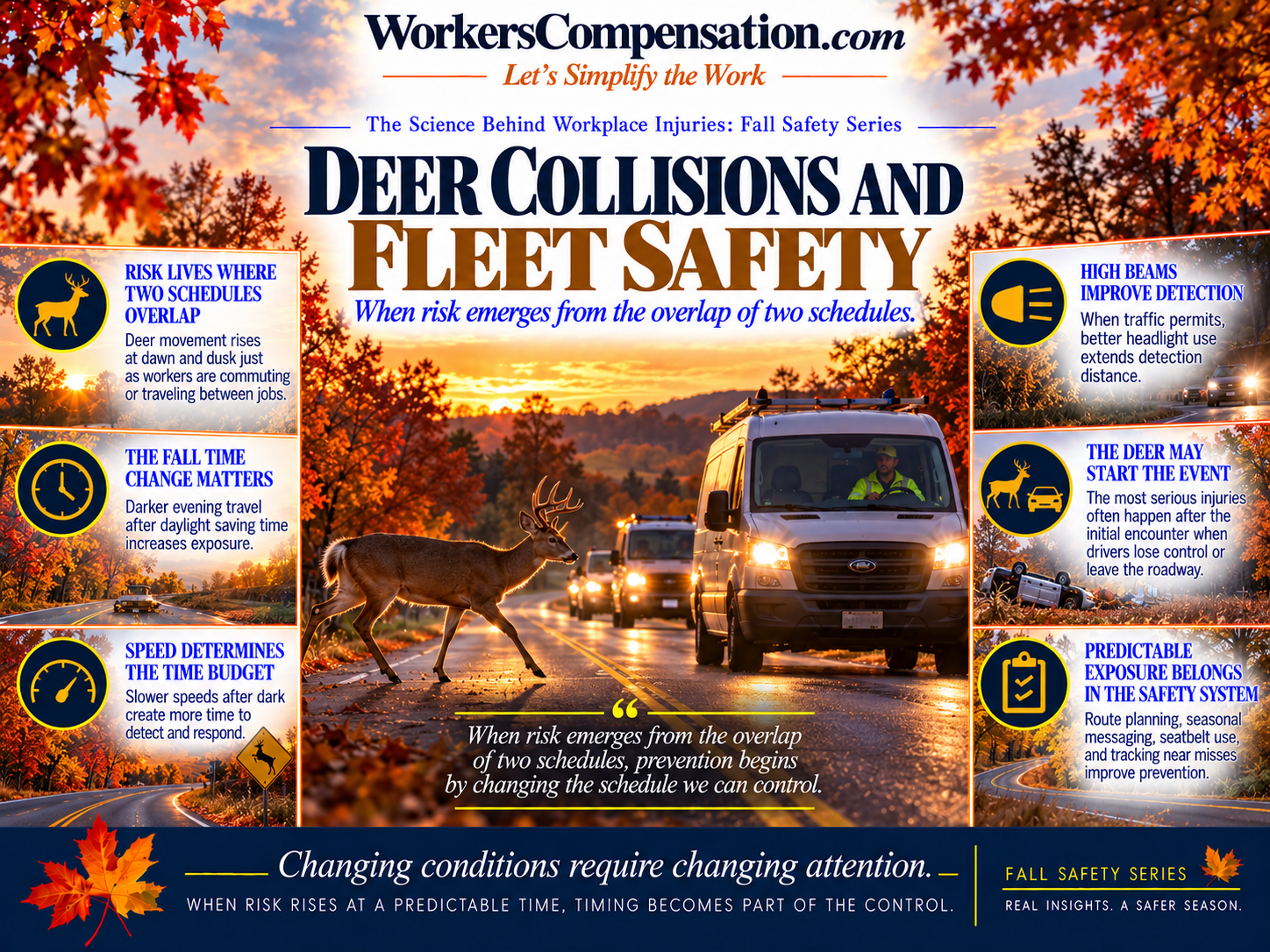
Risk Lives Where Two Schedules Overlap
Deer activity increases around dawn and dusk, while autumn breeding behavior adds movement during the same months daylight disappears earlier from the evening commute. Calum Cunningham and colleagues analyzed more than one million deer-vehicle collisions across 23 states and found collisions were 14 times more frequent two hours after sunset than two hours before sunset. Earlier research from Hannu Haikonen and Heikki Summala similarly identified an extensive collision peak approximately one hour after sunset. Different populations, road systems, and deer species affect the precise numbers, but the broader pattern remains consistent: the transition from daylight into darkness creates a concentrated collision window.
The end of daylight saving time demonstrates what happens when the human side of that schedule changes. Deer do not adjust their movement because clocks move backward; people suddenly begin making the same evening trips under darker conditions. Cunningham and colleagues found deer-vehicle collisions increased 16% during the week following the fall time change. That finding creates an important workplace opportunity because organizations influence shift changes, dispatch times, delivery windows, appointments, and route schedules. Some travel during the highest-risk period will remain unavoidable, but employers can identify routes with repeated animal activity, reconsider discretionary rural travel near sunset, and adjust expectations when workers are driving through known wildlife corridors.
Speed Determines the Driver's Time Budget
Once a deer enters the roadway, the driver's available time becomes extremely limited. At 55 miles per hour, a vehicle travels approximately 81 feet every second. Research on driver perception and braking has found that responding to an unexpected object can require substantially more time than responding to an anticipated signal because the brain must first recognize and interpret the unexpected event. Darkness further reduces the distance available for that process because the driver can only respond to a hazard after enough visual information reaches the brain. A driver can therefore feel completely capable of controlling the vehicle while having considerably less time to detect an animal than daytime driving would provide.
The deer does not reliably compensate for the vehicle's closing speed. Bradley Blackwell, Thomas Seamans, and Travis DeVault studied free-ranging white-tailed deer exposed to approaching vehicles at different speeds and found deer did not consistently begin fleeing earlier as vehicle speed increased. Median time to collision when the deer began to flee was only 4.6 seconds, and approximately 36% of approaches ended with deer crossing in front of the vehicle. The animal's behavior remained variable while greater vehicle speed continued to consume the driver's available response time. Lower speeds on rural roads after dark therefore create something the driver cannot manufacture once the deer appears: additional time.
Visibility creates another human-performance problem because people do not always recognize their own limitations. High beams can substantially extend the distance available to detect an animal when surrounding traffic permits their use, yet Ian Reagan and colleagues found only 18% of isolated drivers observed on dark roads used them. Drivers surveyed in earlier research reported considerably higher use, suggesting people may sincerely overestimate how consistently they perform a protective behavior. Fleet safety can reduce dependence on self-perception through well-performing headlights, automatic high-beam systems, appropriate speed expectations, and vehicle technology that supports detection and braking.
The Deer May Start the Event Without Causing the Injury
The most serious part of an animal collision often occurs after the initial encounter. Allan Williams and JoAnn Wells examined 147 fatal vehicle-animal crashes across nine states and found deer were involved in 77% of them. Many fatalities resulted from the sequence that followed the animal strike, including vehicles leaving the roadway, colliding with other objects or vehicles, and motorcyclists being thrown from their bikes. National surveillance of nonfatal animal-crash injuries has identified similar patterns when drivers attempted to avoid animals, including vehicles leaving the road, striking trees, poles, or guardrails, and rolling over.
These findings explain why maintaining vehicle control and occupant protection matter so much. In the Williams and Wells fatal-crash sample, 60% of passenger-vehicle occupants who died were unbelted, while 65% of motorcyclists killed were not wearing helmets. The crash pattern also supports the common recommendation to brake firmly while maintaining control instead of making an extreme evasive maneuver, although controlled research directly comparing those responses does not exist. The larger principle is supported more clearly: the initiating event and the injurious event are not always the same. A deer can create the emergency while speed, roadside objects, rollover, ejection, or another vehicle determine the severity of the outcome.
A worker who exits a damaged vehicle on a dark rural shoulder becomes a pedestrian beside moving traffic, potentially under the same limited-visibility conditions that contributed to the original collision. Fleet procedures should address moving the vehicle completely from traffic when possible, activating hazard lights, communicating with dispatch or emergency services, and avoiding contact with an injured animal. Managing the event includes what happens before, during, and immediately after the strike.
Predictable Exposure Belongs in the Safety System
Motor-vehicle crashes represent a disproportionately expensive workers' compensation exposure. NCCI research has found they account for approximately 5% of lost-time claims while generating roughly 10% of associated benefit costs, with average costs exceeding $100,000 in the period studied. Published workers' compensation data do not separate deer collisions from other motor-vehicle events, so deer-specific workers' compensation costs cannot be stated reliably. The broader data still matter because an occupational deer collision enters a category already associated with severe injuries and substantial claim costs.
Employers have several practical controls available: track animal strikes and near misses by location and time, identify routes repeatedly traveled near sunset, reinforce appropriate speeds on rural roads, require occupant protection, and consider headlight performance and driver-assistance technology when purchasing fleet vehicles. Timed seasonal communication may also outperform generic year-round warnings. Research on roadway interventions has found temporary warnings used during periods of increased deer movement can change driver behavior, while permanent wildlife signs often fade into the visual background. Vehicle-mounted deer whistles, despite their popularity, have not demonstrated meaningful effects on deer behavior in controlled testing.
Deer collisions feel random because the individual encounter happens suddenly. The larger exposure is remarkably predictable. Autumn brings a known increase in collisions, sunset creates a concentrated risk window, and changing the human schedule by a single hour measurably changes collision frequency. Employers cannot control deer biology, but they influence when employees travel, how quickly they are expected to move, what vehicles they drive, and how much protection surrounds them when an encounter occurs. When risk emerges from the overlap of two schedules, prevention begins by changing the schedule we can control.
Tomorrow in The Science Behind Workplace Injuries: Fall Safety Series — Hunting Season and Workplace Safety. Autumn places hunters and outdoor workers in overlapping environments. We will examine how visibility, communication, shared land use, and organizational planning can reduce risk when workplace safety depends partly on the behavior of people outside the organization.
Research Referenced
Blackwell, B. F., Seamans, T. W., & DeVault, T. L. (2014). White-tailed deer response to vehicle approach: Evidence of unclear and present danger. PLoS ONE, 9(10), e109988. doi:10.1371/journal.pone.0109988
Cunningham, C. X., Nuñez, T. A., Hentati, Y., Sullender, B., Breen, C., Ganz, T. R., Kreling, S. E. S., Shively, K. A., Reese, E., Miles, J., & Prugh, L. R. (2022). Permanent daylight saving time would reduce deer-vehicle collisions. Current Biology, 32(22), 4982–4988.e4. doi:10.1016/j.cub.2022.10.007
Reagan, I. J., Brumbelow, M. L., Flannagan, M. J., & Sullivan, J. M. (2017). High beam headlamp use rates: Effects of rurality, proximity of other traffic, and roadway curvature. Traffic Injury Prevention, 18(7), 716–723. doi:10.1080/15389588.2016.1228921
Williams, A. F., & Wells, J. K. (2005). Characteristics of vehicle-animal crashes in which vehicle occupants are killed. Traffic Injury Prevention, 6(1), 56–59. doi:10.1080/15389580590903186


AI best practices california case file caselaw case management case management focus claims compensability compliance compliance corner courts do you know the rule employers exclusive remedy florida fraud glossary check Healthcare hr homeroom insurance insurers iowa kentucky leadership NCCI new jersey new york ohio pennsylvania Safety safety at work state info tech technology the case manager violence WDYT what do you think women's history women's history month workers' comp 101 workers' recovery Workplace Safety Workplace Violence
Read Also
About The Author
About The Author
-
Claire Muselman
Meet Dr. Claire C. Muselman, the Chief Operating Officer at WorkersCompensation.com, where she blends her vast academic insight and professional innovation with a uniquely positive energy. As the President of DCM, Dr. Muselman is renowned for her dynamic approach that reshapes and energizes the workers' compensation industry. Dr. Muselman's academic credentials are as remarkable as her professional achievements. Holding a Doctor of Education in Organizational Leadership from Grand Canyon University, she specializes in employee engagement, human behavior, and the science of leadership. Her diverse background in educational leadership, public policy, political science, and dance epitomizes a multifaceted approach to leadership and learning. At Drake University, Dr. Muselman excels as an Assistant Professor of Practice and Co-Director of the Master of Science in Leadership Program. Her passion for teaching and commitment to innovative pedagogy demonstrate her dedication to cultivating future leaders in management, leadership, and business strategy. In the industry, Dr. Muselman actively contributes as an Ambassador for the Alliance of Women in Workers’ Compensation and plays key roles in organizations such as Kids Chance of Iowa, WorkCompBlitz, and the Claims and Litigation Management Alliance, underscoring her leadership and advocacy in workers’ compensation. A highly sought-after speaker, Dr. Muselman inspires professionals with her engaging talks on leadership, self-development, and risk management. Her philosophy of empathetic and emotionally intelligent leadership is at the heart of her message, encouraging innovation and progressive change in the industry. "Empowerment is key to progress. By nurturing today's professionals with empathy and intelligence, we're crafting tomorrow's leaders." - Dr. Claire C. Muselman
More by This Author
Read More
- Oct 08, 2026
- Frank Ferreri
- Oct 08, 2026
- Claire Muselman
- Oct 07, 2026
- Frank Ferreri
- Oct 06, 2026
- Claire Muselman
- Oct 06, 2026
- Chriss Swaney
- Oct 05, 2026
- Claire Muselman