


Share This Article:
Summer Safety Series
Welcome to The Science Behind Workplace Injuries: 30 Days of Summer Safety, where we explore the environmental hazards, human physiology, behavioral science, and organizational decisions shaping workplace safety. This article is part of our July series examining the science behind workplace injuries and the factors influencing workplace safety during the summer months.
Have you ever driven home from work and realized you remembered very little about the drive? You stopped at traffic lights. You stayed in your lane. You arrived safely. Somewhere along the way, your mind drifted to dinner, tomorrow's meeting, or the conversation you had earlier in the day. Maybe you sang the lyrics to a song from 20 years ago, perfectly. The remarkable part is not that your mind wandered. The remarkable part is that your brain successfully completed a familiar task while your conscious attention was focused somewhere else.
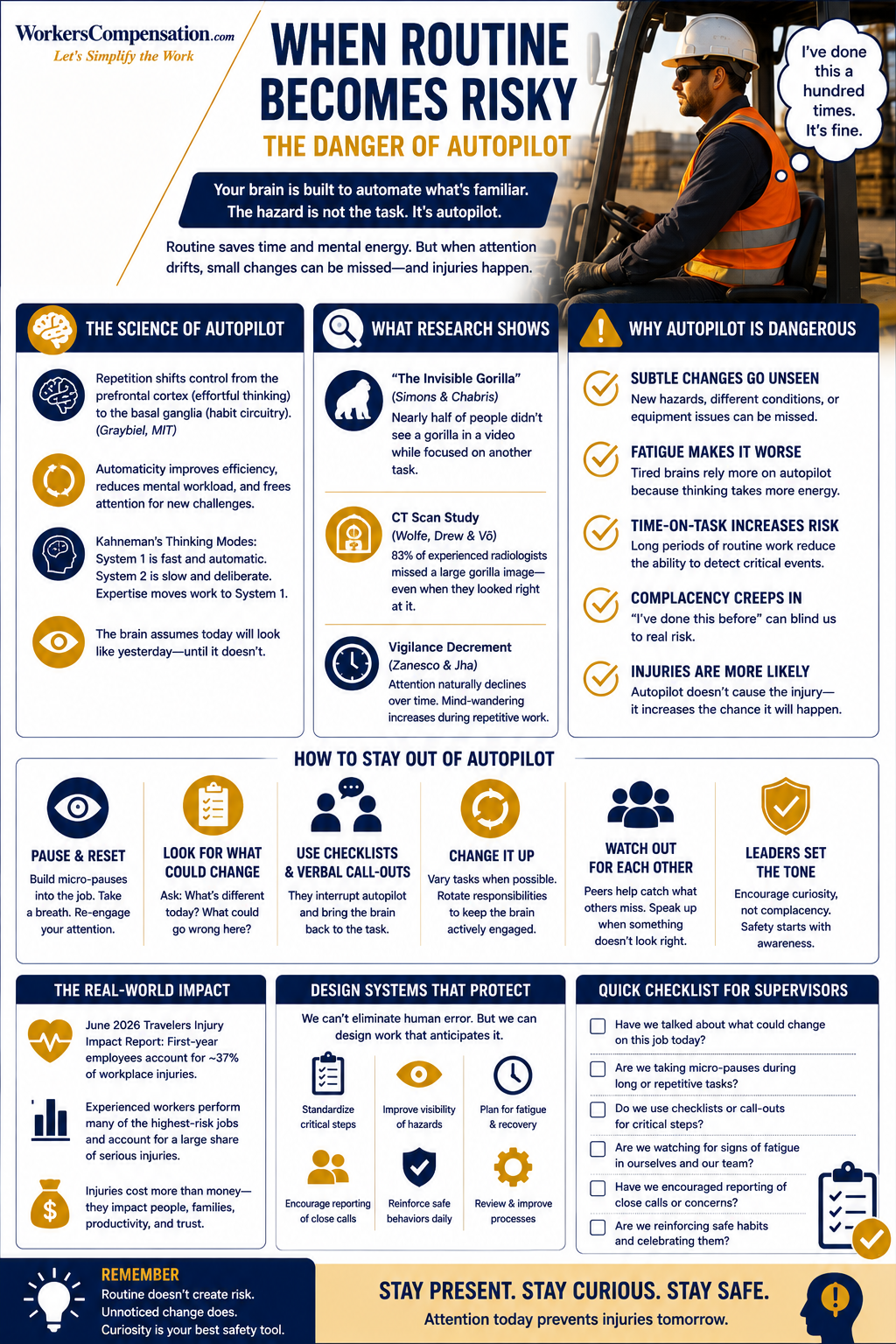
Neuroscientists call this automaticity. It represents one of the brain's most remarkable adaptations. As tasks become familiar, control gradually shifts from the effortful processing of the prefrontal cortex toward the habit circuitry of the basal ganglia. Dr. Ann Graybiel's pioneering research at MIT demonstrated habits become increasingly automatic through repetition, allowing people to perform well-practiced behaviors with remarkably little conscious effort. The adaptation improves efficiency, reduces mental workload, and frees attention for new challenges. Every experienced employee benefits from this remarkable feature of the human brain.
Psychologist Daniel Kahneman described this process through two complementary modes of thinking. System 1operates quickly, automatically, and with little conscious effort. System 2 works more slowly, requiring deliberate attention and analytical thinking. Expertise develops as repeated practice gradually shifts familiar work from System 2 to System 1. The transition allows skilled employees to solve problems efficiently without consciously evaluating every movement or decision. The same neurological efficiency creates an important challenge. When attention shifts away from routine tasks, subtle changes in the environment become easier to overlook.
One of the most fascinating demonstrations of this limitation came from cognitive psychology rather than workplace safety. Daniel Simons and Christopher Chabris asked participants to count basketball passes while a person wearing a gorilla suit walked through the scene, stopped, faced the camera, and beat its chest. Nearly half of the participants never noticed the gorilla because their attention had been directed elsewhere. Years later, Jeremy Wolfe, Trafton Drew, and Melissa Võ repeated a similar experiment with experienced radiologists. Eighty-three percent failed to notice a gorilla image inserted into a CT scan even though the image was forty-eight times larger than the lung nodules they were searching for. More than half looked directly at the gorilla without consciously recognizing it. Expertise improved diagnostic skill. It did not eliminate the biological limits of attention.
Autopilot becomes even more important as time-on-task increases. Researchers describe a phenomenon known as the vigilance decrement, where the ability to detect critical events gradually declines during prolonged periods requiring sustained attention. Anthony Zanesco, Amishi Jha, and their research teams found mind-wandering increases as vigilance decreases, particularly during repetitive tasks requiring continuous monitoring. Ironically, highly reliable and predictable environments often encourage the brain to drift because very little appears to demand conscious attention. The safer yesterday felt, the easier it becomes for the brain to expect today will unfold the same way.
Fatigue magnifies the challenge. As we explored in yesterday's article, sleep loss, heat, dehydration, and prolonged mental effort reduce the brain's available cognitive capacity. Under those conditions, people naturally rely more heavily on automatic processing because deliberate thinking requires additional energy. Dawson and Reid's landmark research demonstrated sustained wakefulness produces impairment comparable to alcohol intoxication. Fatigue does not create autopilot. Fatigue simply makes the brain more likely to remain there.
Human factors researchers have studied this pattern for decades. Jens Rasmussen's Skill-Rule-Knowledge framework explains experienced employees spend much of their day operating at the skill-based level, where well-practiced behaviors occur automatically with very little conscious effort. Skill-based performance is remarkably efficient and highly reliable. It is also where slips and lapses are most likely to occur because attention has shifted away from the mechanics of the task. James Reason expanded this thinking through the Swiss Cheese Model, reminding us injuries rarely result from a single human error. They develop when predictable human limitations align with weaknesses in the surrounding system. The objective is never eliminating human error. The objective is designing systems that anticipate it.
Workers' compensation data reinforce the point. The 2026 Travelers Injury Impact Report, analyzing approximately 1.2 million workers' compensation claims, found first-year employees accounted for roughly thirty-seven percent of workplace injuries. New workers face the challenges of unfamiliar tasks, equipment, and organizational systems. At the same time, experienced employees account for a substantial share of serious injuries because they perform routine work every day and often assume responsibility for the organization's highest-risk activities. Autopilot is not an experience problem. It is a human problem expressed differently across stages of a career.
Leadership becomes the most effective countermeasure because attention cannot be sustained indefinitely through willpower alone. High Reliability Organizations operating in industries such as aviation, nuclear power, and healthcare intentionally design systems that interrupt automatic thinking. Karl Weick and Kathleen Sutcliffe describe principles including preoccupation with failure, sensitivity to operations, reluctance to simplify, commitment to resilience, and deference to expertise. Each principle encourages people to pause, question assumptions, and notice weak signals before they become serious events. Curiosity becomes part of the system rather than depending entirely on the individual.
Simple practices produce the same effect in everyday workplaces. A pre-task discussion asking, "What has changed since yesterday?" encourages deliberate thinking before routine work begins. Rotating responsibilities, discussing near misses, conducting peer observations, and occasionally changing the sequence of familiar tasks all encourage the brain to shift from automatic processing back to conscious attention. Small interruptions often produce significant improvements because they help employees see familiar work with fresh eyes.
Autopilot reminds us one of the brain's greatest strengths can also become one of its greatest vulnerabilities. Automaticity allows people to perform complex work with remarkable efficiency, precision, and confidence. Safe organizations recognize efficiency alone is never the objective. The objective is knowing when routine deserves renewed attention. Curiosity becomes the bridge between experience and awareness because it encourages the brain to notice what familiarity quietly overlooks.
Tomorrow in The Science Behind Workplace Injuries - Decision Fatigue: How Cognitive Exhaustion Can Become Physical Injury. Every decision carries a small cognitive cost. Throughout the day, those costs accumulate until the brain begins looking for shortcuts. Tomorrow, we explore decision fatigue, executive function, and why mental exhaustion often appears as physical injury long before anyone recognizes the connection.


AI california case file caselaw case management case management focus claims compensability compliance compliance corner courts covid do you know the rule employers exclusive remedy florida fraud glossary check Healthcare hr homeroom insurance insurers iowa kentucky leadership NCCI new jersey new york ohio pennsylvania Safety safety at work state info tech technology the case manager violence WDYT what do you think women's history women's history month workers' comp 101 workers' recovery Workplace Safety Workplace Violence
Read Also
About The Author
About The Author
-
Claire Muselman
Meet Dr. Claire C. Muselman, the Chief Operating Officer at WorkersCompensation.com, where she blends her vast academic insight and professional innovation with a uniquely positive energy. As the President of DCM, Dr. Muselman is renowned for her dynamic approach that reshapes and energizes the workers' compensation industry. Dr. Muselman's academic credentials are as remarkable as her professional achievements. Holding a Doctor of Education in Organizational Leadership from Grand Canyon University, she specializes in employee engagement, human behavior, and the science of leadership. Her diverse background in educational leadership, public policy, political science, and dance epitomizes a multifaceted approach to leadership and learning. At Drake University, Dr. Muselman excels as an Assistant Professor of Practice and Co-Director of the Master of Science in Leadership Program. Her passion for teaching and commitment to innovative pedagogy demonstrate her dedication to cultivating future leaders in management, leadership, and business strategy. In the industry, Dr. Muselman actively contributes as an Ambassador for the Alliance of Women in Workers’ Compensation and plays key roles in organizations such as Kids Chance of Iowa, WorkCompBlitz, and the Claims and Litigation Management Alliance, underscoring her leadership and advocacy in workers’ compensation. A highly sought-after speaker, Dr. Muselman inspires professionals with her engaging talks on leadership, self-development, and risk management. Her philosophy of empathetic and emotionally intelligent leadership is at the heart of her message, encouraging innovation and progressive change in the industry. "Empowerment is key to progress. By nurturing today's professionals with empathy and intelligence, we're crafting tomorrow's leaders." - Dr. Claire C. Muselman
More by This Author
Read More
- Sep 11, 2026
- Claire Muselman
- Sep 11, 2026
- Frank Ferreri
- Sep 09, 2026
- Chris Parker
- Sep 09, 2026
- Claire Muselman
- Sep 09, 2026
- Frank Ferreri
- Sep 09, 2026
- Chris Parker