


Share This Article:
Safety at Work
Tick exposure can be a summer nuisance. For employers with outdoor workers, it is also a workplace safety issue that deserves the same planning as other seasonal hazards. As warmer months extend and tick activity increases in many regions, employers have an opportunity to reduce exposure before a bite turns into a medical concern or a workers’ compensation claim. That opportunity begins with recognizing tick exposure as a foreseeable risk connected to the environment where work occurs. Strong prevention gives employers a practical way to protect people before avoidable harm enters the claims process.
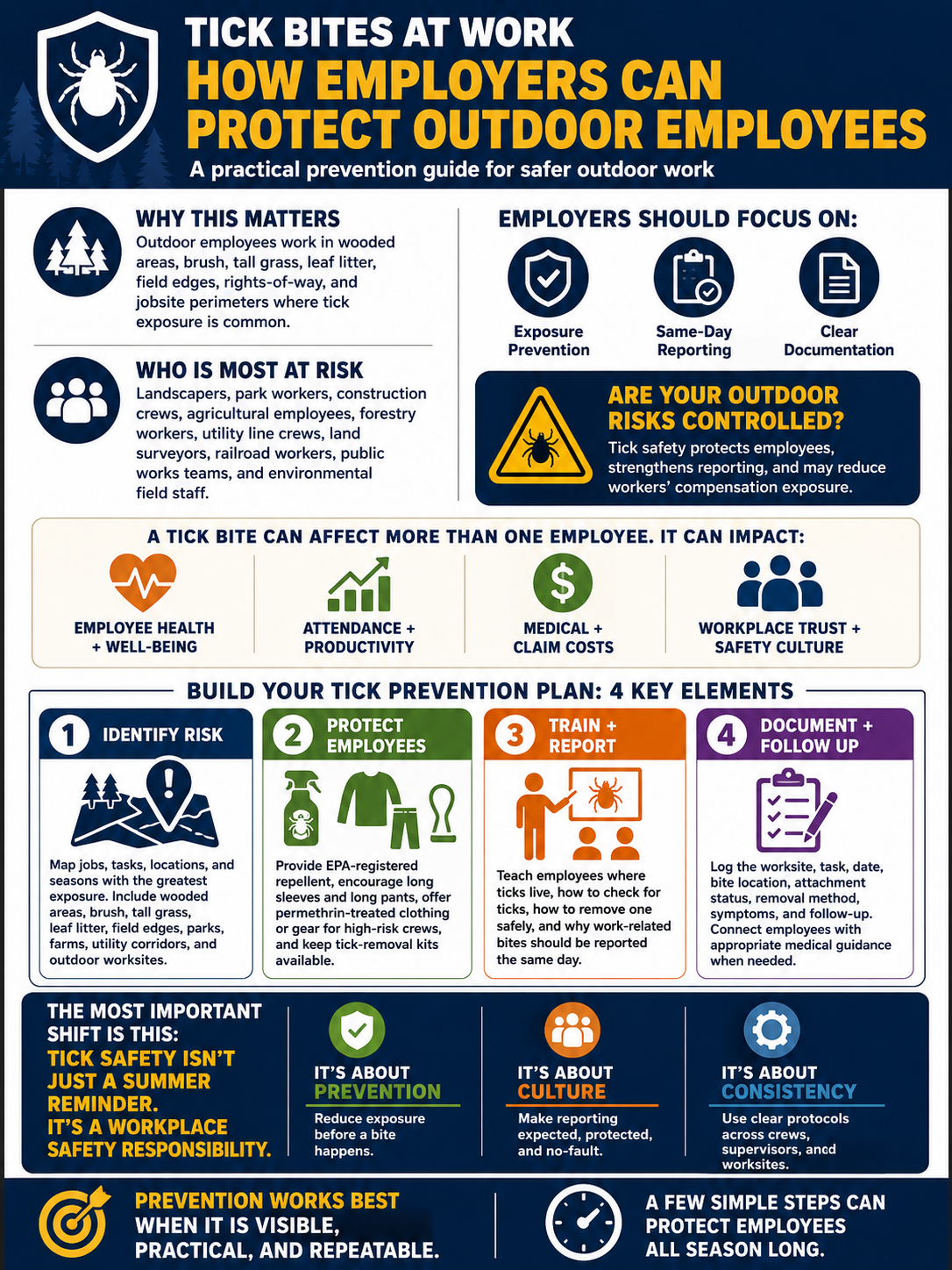
Outdoor workers are vulnerable because their jobs often place them directly in tick habitat. Landscapers, park workers, construction crews, agricultural employees, forestry workers, utility line workers, land surveyors, railroad workers, public works employees, and environmental field staff may spend hours in wooded areas, brush, tall grass, leaf litter, field edges, rights-of-way, and outdoor jobsite perimeters. These environments create routine opportunities for exposure during work that may feel normal to the employee. Employers should treat environmental conditions as part of the job hazard assessment rather than a personal wellness reminder pushed onto the worker. Prevention becomes stronger when the organization owns the hazard instead of hoping each employee manages the risk alone.
The best employer response begins with hazard recognition. Safety teams should identify which jobs, tasks, locations, and seasons create the most exposure. A worker’s job title alone may not tell the full story because tick risk is often tied to the specific worksite, vegetation, route, and task being performed that day. A construction employee on a paved urban site may face limited exposure, while a construction employee working near overgrown vegetation or utility corridors may face a much higher risk. The same logic applies to public works teams, campus grounds crews, parks employees, and field inspection teams that move between low-risk and high-risk environments throughout the day.
Once the risk is identified, employers should build tick safety into regular field operations. Seasonal safety talks, job hazard assessments, toolbox talks, onboarding, and supervisor training give employees the information they need before exposure occurs. Employees should understand where ticks live, how exposure happens, how to use repellent, how to check for ticks, how to remove a tick safely, and when to report symptoms. Supervisors should understand how to respond to a reported bite, how to document the incident, and when to involve occupational health or a medical provider. Training works best when the process is simple enough to remember and repeat during a busy field day.
Practical prevention does not have to be complicated. Employers can provide EPA-registered insect repellent at dispatch locations, in work vehicles, at job trailers, and inside field kits. High-risk crews may benefit from permethrin-treated clothing or gear along with long-sleeved shirts, long pants, socks, and light-colored clothing when feasible. Worksite controls also matter because employers can reduce exposure by mowing tall grass, cutting back brush, removing leaf litter, and reducing overgrown edges where they control the property. These steps lower the chance of contact before the employee ever has to rely on a tick check after the shift.
The post-bite response carries as much importance as the prevention plan. Employees should be encouraged to report work-related tick bites the same day, even when they feel fine. Same-day reporting creates a clear record of exposure, gives the employee appropriate guidance, and allows the employer to spot patterns before they become larger safety concerns. A reported bite is easier to document and evaluate when the worksite, task, and timing are still fresh. A vague exposure remembered weeks later after symptoms appear creates confusion for the employee, the employer, the medical provider, and the claims process.
Employers should maintain a simple tick-bite log for outdoor workforces. The log should include the employee’s worksite, job task, date, time reported, location of the bite on the body, whether the tick was attached, estimated attachment time if known, removal method, repellent or protective clothing used, symptoms, medical referral, and follow-up. This documentation supports employee care because the organization can respond with consistency. It also supports claim defensibility because the facts are preserved close to the event. Strong documentation turns scattered field reports into meaningful safety data the employer can use to improve prevention.
Employers should not turn supervisors into clinicians. The employer’s role is to prevent exposure, support prompt reporting, document the incident, and connect employees with appropriate medical guidance when needed. Medical treatment decisions should remain with qualified healthcare professionals. Employees should be advised to seek medical evaluation when symptoms develop after a tick bite, including rash, fever, fatigue, headache, muscle aches, or joint pain. A clear protocol protects the employee without asking the supervisor to diagnose or minimize a potential tick-borne illness.
A strong tick safety program also supports workplace culture. Employees are more likely to report bites and symptoms when they know the process is expected, protected, and no-fault. Reporting should never be treated as an inconvenience or a sign someone did something wrong. It should be treated as an early warning system that protects the employee, improves the worksite, and strengthens the employer’s ability to manage risk. When workers trust the process, prevention becomes part of the culture instead of another seasonal reminder that gets ignored.
Tick prevention is a low-cost, high-value safety strategy. Employers do not need to wait for a complicated claim or delayed diagnosis before taking action. When outdoor work places employees in known tick habitat, prevention is the better path for the worker and the organization. The strongest employers will make tick safety visible, practical, and repeatable before the season creates avoidable harm. That is how safety leaders protect employees, support supervisors, and reduce workers’ compensation exposure with common-sense prevention.
Employer Tick Safety Checklist
☐ Identify outdoor jobs, tasks, and worksites with tick exposure.
☐ Add tick exposure to job hazard assessments and seasonal safety talks.
☐ Provide EPA-registered insect repellent at dispatch points, vehicles, job trailers, and field kits.
☐ Offer permethrin-treated clothing or gear for high-risk outdoor crews.
☐ Encourage long sleeves, long pants, socks, and light-colored clothing when feasible.
☐ Reduce tick habitat where possible by mowing tall grass, cutting back brush, and removing leaf litter.
☐ Provide tick-removal kits with fine-tipped tweezers, antiseptic wipes, and reporting instructions.
☐ Train employees to report work-related tick bites the same day.
☐ Document the worksite, task, date, bite location, attachment status, removal method, symptoms, and follow-up.
☐ Create a clear occupational health referral process for symptoms or employee concerns.
☐ Review tick-bite reports during the season to identify repeat exposure locations.
☐ Reinforce that reporting tick bites and symptoms is expected, protected, and part of prevention.


AI best practices california case file caselaw case management case management focus claims compensability compliance compliance corner courts do you know the rule employers exclusive remedy florida fraud glossary check Healthcare hr homeroom insurance insurers iowa kentucky leadership NCCI new jersey new york ohio pennsylvania Safety safety at work state info tech technology the case manager violence WDYT what do you think women's history women's history month workers' comp 101 workers' recovery Workplace Safety Workplace Violence
Read Also
About The Author
About The Author
-
Claire Muselman
Meet Dr. Claire C. Muselman, the Chief Operating Officer at WorkersCompensation.com, where she blends her vast academic insight and professional innovation with a uniquely positive energy. As the President of DCM, Dr. Muselman is renowned for her dynamic approach that reshapes and energizes the workers' compensation industry. Dr. Muselman's academic credentials are as remarkable as her professional achievements. Holding a Doctor of Education in Organizational Leadership from Grand Canyon University, she specializes in employee engagement, human behavior, and the science of leadership. Her diverse background in educational leadership, public policy, political science, and dance epitomizes a multifaceted approach to leadership and learning. At Drake University, Dr. Muselman excels as an Assistant Professor of Practice and Co-Director of the Master of Science in Leadership Program. Her passion for teaching and commitment to innovative pedagogy demonstrate her dedication to cultivating future leaders in management, leadership, and business strategy. In the industry, Dr. Muselman actively contributes as an Ambassador for the Alliance of Women in Workers’ Compensation and plays key roles in organizations such as Kids Chance of Iowa, WorkCompBlitz, and the Claims and Litigation Management Alliance, underscoring her leadership and advocacy in workers’ compensation. A highly sought-after speaker, Dr. Muselman inspires professionals with her engaging talks on leadership, self-development, and risk management. Her philosophy of empathetic and emotionally intelligent leadership is at the heart of her message, encouraging innovation and progressive change in the industry. "Empowerment is key to progress. By nurturing today's professionals with empathy and intelligence, we're crafting tomorrow's leaders." - Dr. Claire C. Muselman
More by This Author
Read More
- Oct 16, 2026
- Claire Muselman
- Oct 14, 2026
- Claire Muselman
- Oct 14, 2026
- Frank Ferreri
- Oct 13, 2026
- Claire Muselman
- Oct 13, 2026
- Frank Ferreri
- Oct 12, 2026
- Claire Muselman