


Share This Article:
Summer Safety Series
Welcome to The Science Behind Workplace Injuries: 30 Days of Summer Safety, where we explore the environmental hazards, human physiology, behavioral science, and organizational decisions shaping workplace safety. This article is part of our July series examining the science behind workplace injuries and the factors influencing workplace safety during the summer months.
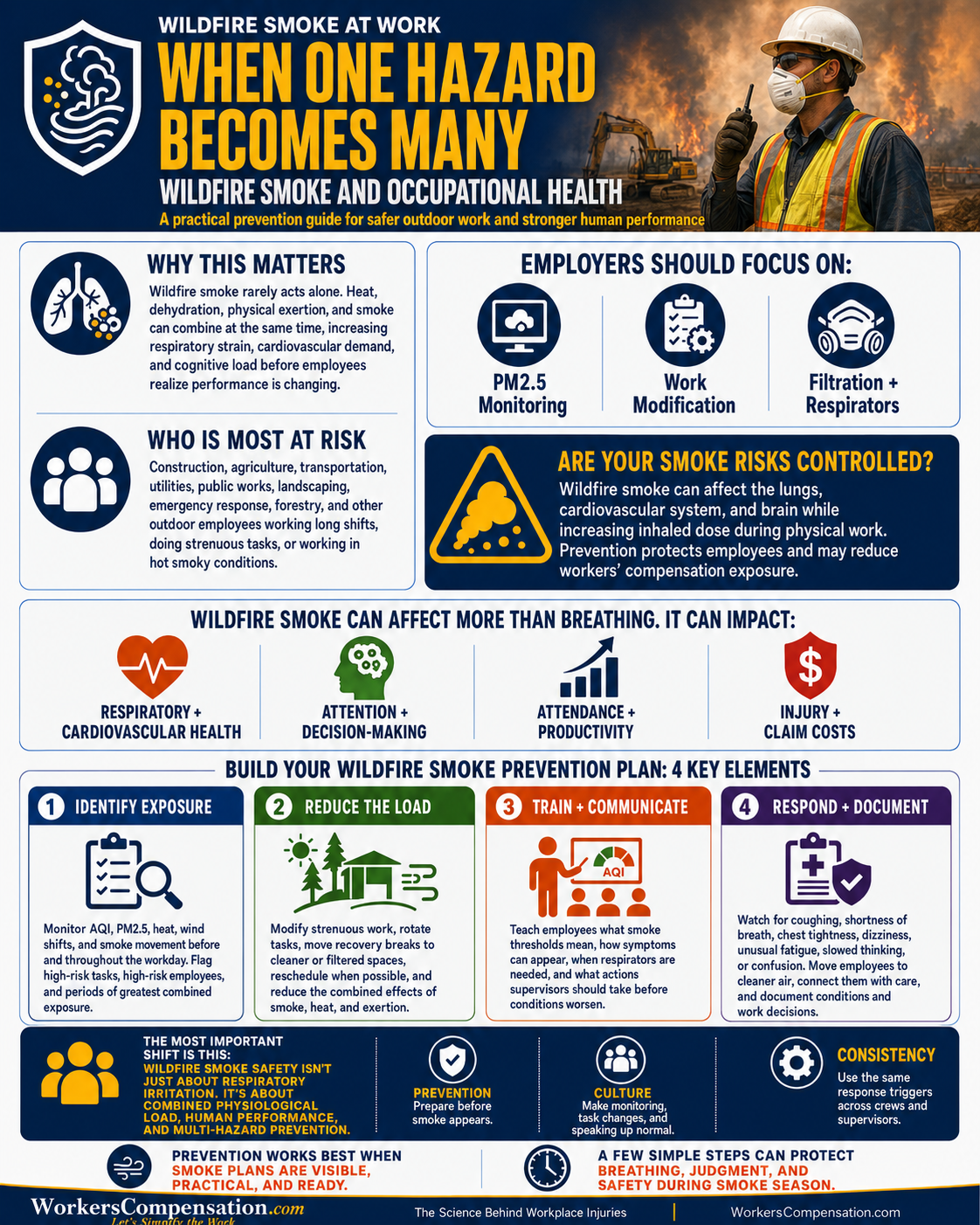
Workplace hazards rarely arrive one at a time. A construction worker begins the afternoon working in ninety-degree heat. Dehydration gradually develops as the shift continues. Wildfire smoke settles across the jobsite, reducing air quality without changing the day's production schedule. Physical exertion increases breathing rate, allowing fine particulate matter to penetrate deeper into the lungs. The cardiovascular system works harder to regulate body temperature while simultaneously responding to inflammation triggered by smoke exposure. The brain is expected to maintain attention, judgment, communication, and reaction time under conditions it was never designed to manage simultaneously. None of the hazards exists in isolation and neither should prevention.
Wildfire smoke is often described as an air quality issue. Smoke is a complex mixture of fine particulate matter, carbon monoxide, nitrogen oxides, volatile organic compounds, polycyclic aromatic hydrocarbons, and other combustion byproducts. Fine particulate matter, commonly known as PM2.5, receives the greatest attention because particles small enough to bypass the body's normal airway defenses can travel deep into the lungs and eventually enter the bloodstream. The lungs receive the initial exposure, and the physiological response extends throughout the respiratory system, cardiovascular system, immune system, and brain.
Employers tend to think about wildfire smoke as a respiratory hazard, but physiology does not separate the body into individual systems. Inflammation affecting the lungs also increases cardiovascular demand. Cardiovascular strain influences heat tolerance. Reduced oxygen delivery and systemic inflammation affect cognitive performance. Physical exertion increases inhaled dose by increasing breathing rate. The body experiences one integrated physiological workload rather than a collection of independent exposures. Understanding that interaction changes how organizations think about prevention.
Researchers have spent the past several years redefining how wildfire smoke affects human health. Gould's 2024 review in the Annual Review of Medicine synthesized wildfire smoke epidemiology and found consistent associations with respiratory hospitalizations and all-cause mortality. Wah's 2025 systematic review in Respiratory Medicine examined occupational wildfire and prescribed-burn exposure and found adverse respiratory effects in twenty-four of twenty-six studies, including reduced lung function, airway inflammation, respiratory symptoms, and evidence suggesting longer-term pulmonary consequences for repeatedly exposed workers. Different investigators examined different populations. Both reached the same conclusion. Wildfire smoke represents far more than a temporary respiratory irritant.
The brain has become one of the fastest-growing areas of wildfire smoke research. Cleland's 2022 study published in Environmental Health Perspectives followed more than 10,000 adults and found short-term wildfire smoke exposure reduced attention within hours and days of exposure. Zhu's 2024 study in Nature Mental Health linked wildfire smoke exposure with nearly 1.9 million anxiety-related emergency department visits across the western United States, demonstrating smoke influences emotional regulation alongside cognitive performance. Emerging neurological research suggests inflammatory signaling, oxidative stress, and changes affecting the blood-brain barrier may contribute to declining attention, decision-making, and mental performance during smoke events. Smoke begins influencing human performance before employees associate exposure with changing cognitive function.
Workers' compensation professionals should find the next discovery particularly interesting because it expands the conversation beyond occupational disease. Cabral and Dillender's analysis of Texas workers' compensation data found every additional day of wildfire smoke coverage increased workplace injury claims by approximately 2.8 percent. Smoke was not simply producing respiratory illnesses. Injury frequency increased as well. Finding suggests smoke changes the conditions under which employees perform their work, increasing the likelihood of falls, equipment incidents, motor vehicle crashes, and other traumatic injuries before smoke ever appears on the First Report of Injury. Workers' compensation claims document the injury while environmental physiology explains why the injury occurred.
Behavioral science helps explain why wildfire smoke remains difficult to manage operationally. Employees generally recognize smoke is unpleasant. Recognition alone rarely changes behavior. Agricultural research has repeatedly found inconsistent knowledge surrounding protective measures, uneven supervisor training, and communication gaps affecting symptom recognition and respirator use. Graves' 2025 survey of Washington agricultural supervisors found eighty percent reported personal smoke exposure while supervising outdoor crews, although only sixty-three percent had received training on managing smoke-related symptoms. Leadership occurs inside the exposure rather than outside it. Supervisors make decisions about work pace, recovery breaks, task modification, respirator use, and medical evaluation while experiencing the same environmental conditions as the employees they lead.
Preparation determines whether wildfire smoke becomes a disruption or another operational challenge an organization is ready to manage. OSHA's respiratory protection standard emphasizes engineering controls before personal protective equipment whenever feasible. California, Washington, and Oregon have expanded that philosophy through wildfire smoke standards encouraging employers to monitor PM2.5 conditions, establish predetermined work modification triggers, improve filtration, provide NIOSH-approved respirators, train supervisors before smoke season begins, and create communication systems employees understand. Effective wildfire smoke programs begin long before smoke appears on the horizon because preparation always outperforms reaction.
Human physiology does not distinguish between separate workplace hazards. Heat, dehydration, smoke, physical exertion, fatigue, and psychological stress accumulate within the same body at the same time. Effective prevention recognizes the interaction long before an injury report documents the outcome. Organizations protecting employees most successfully understand how multiple hazards combine to influence human performance.
Tomorrow in The Science Behind Workplace Injuries - Lightning Safety: The Fastest Hazard Requires the Earliest Decisions. Lightning injuries develop in seconds, although prevention begins long before the first storm cloud appears. Tomorrow, we explore why weather awareness, decision-making, and organizational culture determine whether employees remain safe when conditions change faster than work schedules.


AI best practices california case file caselaw case management case management focus claims compensability compliance compliance corner courts do you know the rule employers exclusive remedy florida fraud glossary check Healthcare hr homeroom insurance insurers iowa kentucky leadership NCCI new jersey new york ohio pennsylvania Safety safety at work state info tech technology the case manager violence WDYT what do you think women's history women's history month workers' comp 101 workers' recovery Workplace Safety Workplace Violence
Read Also
About The Author
About The Author
-
Claire Muselman
Meet Dr. Claire C. Muselman, the Chief Operating Officer at WorkersCompensation.com, where she blends her vast academic insight and professional innovation with a uniquely positive energy. As the President of DCM, Dr. Muselman is renowned for her dynamic approach that reshapes and energizes the workers' compensation industry. Dr. Muselman's academic credentials are as remarkable as her professional achievements. Holding a Doctor of Education in Organizational Leadership from Grand Canyon University, she specializes in employee engagement, human behavior, and the science of leadership. Her diverse background in educational leadership, public policy, political science, and dance epitomizes a multifaceted approach to leadership and learning. At Drake University, Dr. Muselman excels as an Assistant Professor of Practice and Co-Director of the Master of Science in Leadership Program. Her passion for teaching and commitment to innovative pedagogy demonstrate her dedication to cultivating future leaders in management, leadership, and business strategy. In the industry, Dr. Muselman actively contributes as an Ambassador for the Alliance of Women in Workers’ Compensation and plays key roles in organizations such as Kids Chance of Iowa, WorkCompBlitz, and the Claims and Litigation Management Alliance, underscoring her leadership and advocacy in workers’ compensation. A highly sought-after speaker, Dr. Muselman inspires professionals with her engaging talks on leadership, self-development, and risk management. Her philosophy of empathetic and emotionally intelligent leadership is at the heart of her message, encouraging innovation and progressive change in the industry. "Empowerment is key to progress. By nurturing today's professionals with empathy and intelligence, we're crafting tomorrow's leaders." - Dr. Claire C. Muselman
More by This Author
Read More
- Oct 17, 2026
- Claire Muselman
- Oct 17, 2026
- Frank Ferreri
- Oct 16, 2026
- Claire Muselman
- Oct 14, 2026
- Claire Muselman
- Oct 14, 2026
- Frank Ferreri
- Oct 13, 2026
- Claire Muselman