


Share This Article:
Summer Safety Series
Welcome to The Science Behind Workplace Injuries: 30 Days of Summer Safety, where we explore the environmental hazards, human physiology, behavioral science, and organizational decisions shaping workplace safety. This article is part of our July series examining the science behind workplace injuries and the factors influencing workplace safety during the summer months.
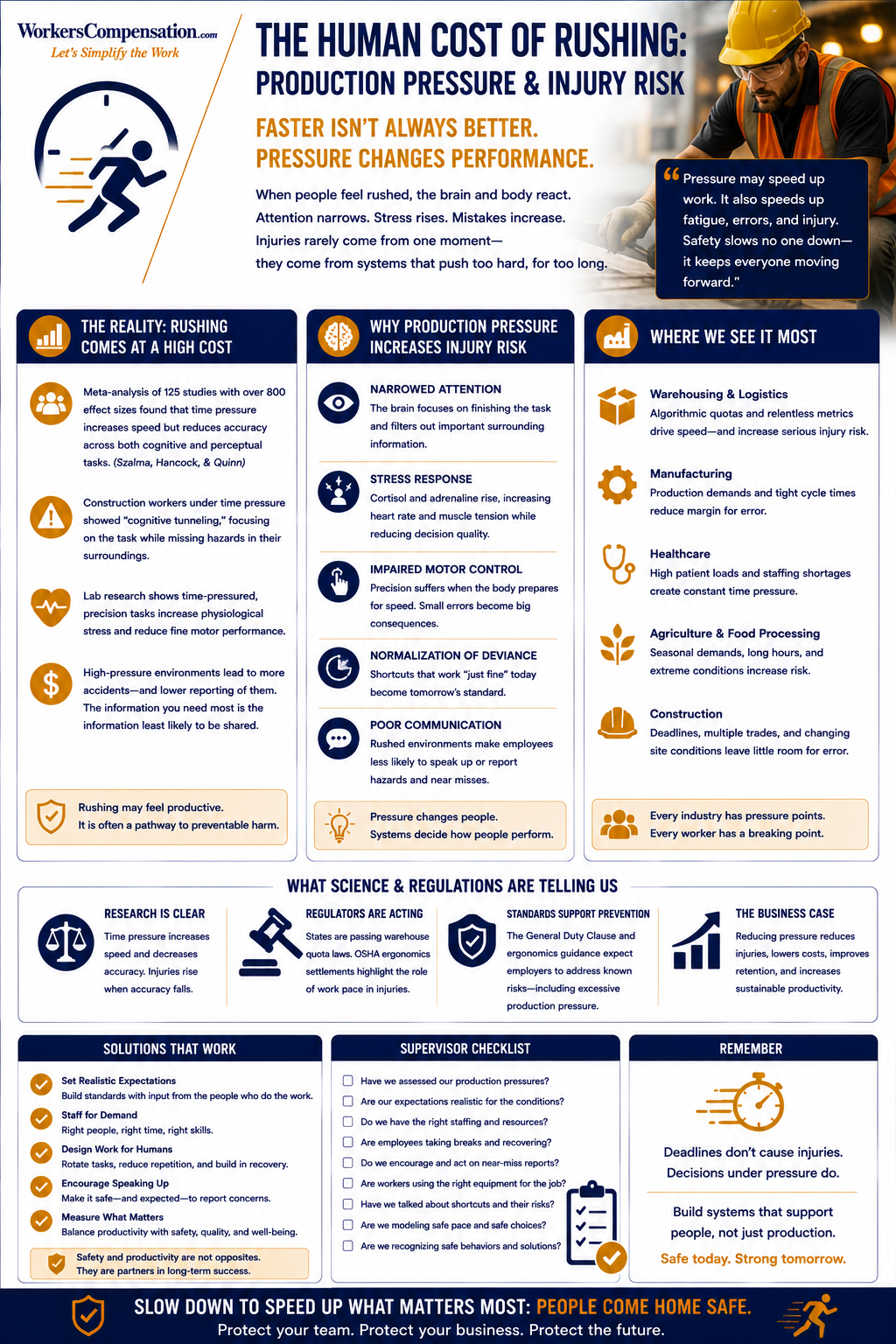
Hurry, hurry, hurry! Rush, rush rush! The moment people perceive they are running out of time, the brain and body begin changing. Heart rate increases. Cortisol and adrenaline rise. Attention narrows. The brain shifts its focus toward completing the immediate task while devoting fewer cognitive resources to the surrounding environment. Employees often move faster. They also become less likely to recognize changing hazards, notice subtle warning signs, or adapt when conditions unexpectedly change. Production pressure influences much more than pace. It changes human performance.
Researchers have studied this relationship for decades. One of the largest meta-analyses examining time pressure, conducted by Arthur Szalma, Peter Hancock, and Kevin Quinn, synthesized findings from 125 studies representing more than 800 effect sizes. Their conclusion was remarkably consistent. Time pressure increased speed while reducing accuracy across both perceptual and cognitive tasks. Workers completed tasks more quickly, although the very abilities supporting safe decision-making became less reliable. Faster did not necessarily mean better.
Modern neuroscience helps explain why. Recent construction studies using functional near-infrared spectroscopy, electroencephalography, and eye-tracking technologies found workers operating under time pressure developed cognitive tunneling, a phenomenon in which attention becomes so focused on one objective that surrounding hazards receive less processing. Participants looked toward their work while overlooking risks developing around them. This finding should sound familiar. We explored similar changes in our discussions of stress, fatigue, and situational awareness. The brain's attentional capacity remains finite regardless of the source of the demand.
Pressure also changes movement itself. Recent laboratory research found time-pressured tasks requiring rapid and precise movements produced measurable physiological stress while reducing fine motor performance. Tasks demanding precision become more difficult exactly when workers feel the strongest pressure to complete them quickly. The body prepares for speed. The work often requires accuracy. Those competing demands create one of the hidden pathways linking production pressure to workplace injuries.
The consequences extend far beyond the laboratory. Warehousing, logistics, manufacturing, healthcare, agriculture, and construction all experience periods where productivity expectations increase substantially. Research examining warehouse operations found organizations relying heavily on algorithmic quotas and production metrics experienced significantly higher serious injury rates than comparable operations. The science does not suggest productivity causes injuries. It demonstrates how organizational systems influence the physiological and cognitive demands placed on the people performing the work.
Behavioral science also explains why rushing gradually becomes part of an organization's culture. Diane Vaughan's work on normalization of deviance demonstrated repeated success under production pressure slowly changes what employees consider acceptable. A shortcut that saves a few seconds without immediate consequences becomes tomorrow's standard practice. Safety procedures begin feeling optional rather than essential because the faster approach has "always worked before." Over time, the exception quietly becomes the expectation.
Production pressure influences communication as well. Researchers have found employees working under intense production demands experience more workplace accidents while becoming less likely to report them. The irony is striking. Organizations often need information most when production pressure is highest, yet those same conditions make employees less likely to speak up about hazards, near misses, or unsafe conditions. We explored this same pattern in our discussion of the bystander effect. Time pressure changes behavior long before an injury occurs.
Workers' compensation professionals increasingly recognize rushing as an upstream contributor rather than a root cause. A strained shoulder, back injury, vehicle collision, or equipment incident may appear to result from one isolated decision. Looking deeper often reveals unrealistic production expectations, inadequate staffing, repetitive work, fatigue, insufficient recovery, or incentive systems rewarding speed above all else. Those organizational conditions shape human performance every day, often long before anyone recognizes the growing risk.
The regulatory landscape is beginning to reflect that understanding. Several states have enacted warehouse quota laws requiring employers to disclose productivity expectations and prohibiting quotas that interfere with meal breaks, rest periods, or compliance with workplace safety requirements. OSHA's corporate-wide ergonomics settlement with Amazon similarly recognized work pace as an important contributor to musculoskeletal injury risk. Regulators are increasingly asking organizations to examine the systems surrounding work rather than focusing exclusively on the individual worker.
Leadership remains the most effective intervention. Realistic staffing, thoughtful scheduling, task rotation, micro-breaks, near-miss reporting, and performance measures balancing productivity with safety all reduce unnecessary production pressure without sacrificing operational excellence. Employees perform their best work when they have the time, resources, and support needed to think clearly. High-performing organizations recognize sustainable productivity depends on protecting human capacity rather than continually consuming it.
The science does not suggest organizations should lower expectations or abandon ambitious goals. It suggests designing systems that recognize how the human brain performs under pressure. People can work efficiently while remaining safe when production expectations align with human capability. The strongest organizations understand productivity and safety are not competing priorities. They are complementary outcomes of well-designed work.
Tomorrow in The Science Behind Workplace Injuries - Why New Employees Are More Likely to Get Hurt During Summer. Every experienced employee was once new. Tomorrow, we explore why new employees face a greater risk of workplace injury, how the brain learns unfamiliar work, and what organizations can do to accelerate competence while protecting safety.


AI best practices california case file caselaw case management case management focus claims compensability compliance compliance corner courts do you know the rule employers exclusive remedy florida fraud glossary check Healthcare hr homeroom insurance insurers iowa kentucky leadership NCCI new jersey new york ohio pennsylvania Safety safety at work state info tech technology the case manager violence WDYT what do you think women's history women's history month workers' comp 101 workers' recovery Workplace Safety Workplace Violence
Read Also
About The Author
About The Author
-
Claire Muselman
Meet Dr. Claire C. Muselman, the Chief Operating Officer at WorkersCompensation.com, where she blends her vast academic insight and professional innovation with a uniquely positive energy. As the President of DCM, Dr. Muselman is renowned for her dynamic approach that reshapes and energizes the workers' compensation industry. Dr. Muselman's academic credentials are as remarkable as her professional achievements. Holding a Doctor of Education in Organizational Leadership from Grand Canyon University, she specializes in employee engagement, human behavior, and the science of leadership. Her diverse background in educational leadership, public policy, political science, and dance epitomizes a multifaceted approach to leadership and learning. At Drake University, Dr. Muselman excels as an Assistant Professor of Practice and Co-Director of the Master of Science in Leadership Program. Her passion for teaching and commitment to innovative pedagogy demonstrate her dedication to cultivating future leaders in management, leadership, and business strategy. In the industry, Dr. Muselman actively contributes as an Ambassador for the Alliance of Women in Workers’ Compensation and plays key roles in organizations such as Kids Chance of Iowa, WorkCompBlitz, and the Claims and Litigation Management Alliance, underscoring her leadership and advocacy in workers’ compensation. A highly sought-after speaker, Dr. Muselman inspires professionals with her engaging talks on leadership, self-development, and risk management. Her philosophy of empathetic and emotionally intelligent leadership is at the heart of her message, encouraging innovation and progressive change in the industry. "Empowerment is key to progress. By nurturing today's professionals with empathy and intelligence, we're crafting tomorrow's leaders." - Dr. Claire C. Muselman
More by This Author
Read More
- Oct 17, 2026
- Claire Muselman
- Oct 17, 2026
- Frank Ferreri
- Oct 16, 2026
- Claire Muselman
- Oct 14, 2026
- Claire Muselman
- Oct 14, 2026
- Frank Ferreri
- Oct 13, 2026
- Claire Muselman