


Share This Article:
Leadership’s Role in Summer Safety: Creating a Culture Where People Speak Up
31 Jul, 2026 Claire Muselman
Summer Safety Series
Policies establish expectations. Leaders determine whether people believe those expectations are safe to follow. Workplace safety depends on whether employees feel safe enough to use their voice when something feels wrong. A worker may notice dizziness during a hot shift. A crew member may see equipment operating too close to a pedestrian path. A new employee may feel unsure about a task but hesitate to ask for help. In each moment, the decision to speak up is shaped less by the policy manual and more by what the employee has learned from leadership behavior.
Heat provides a powerful example. As body temperature rises, the same cognitive functions employees need for sound judgment begin to weaken. Attention narrows. Reaction time slows. Executive function becomes less reliable. Research on heat exposure shows workers may continue believing they can push through even as their ability to accurately assess risk begins to decline. That is why prevention cannot rely solely on self-monitoring. The body experiencing the hazard may also be the body least able to recognize it clearly.
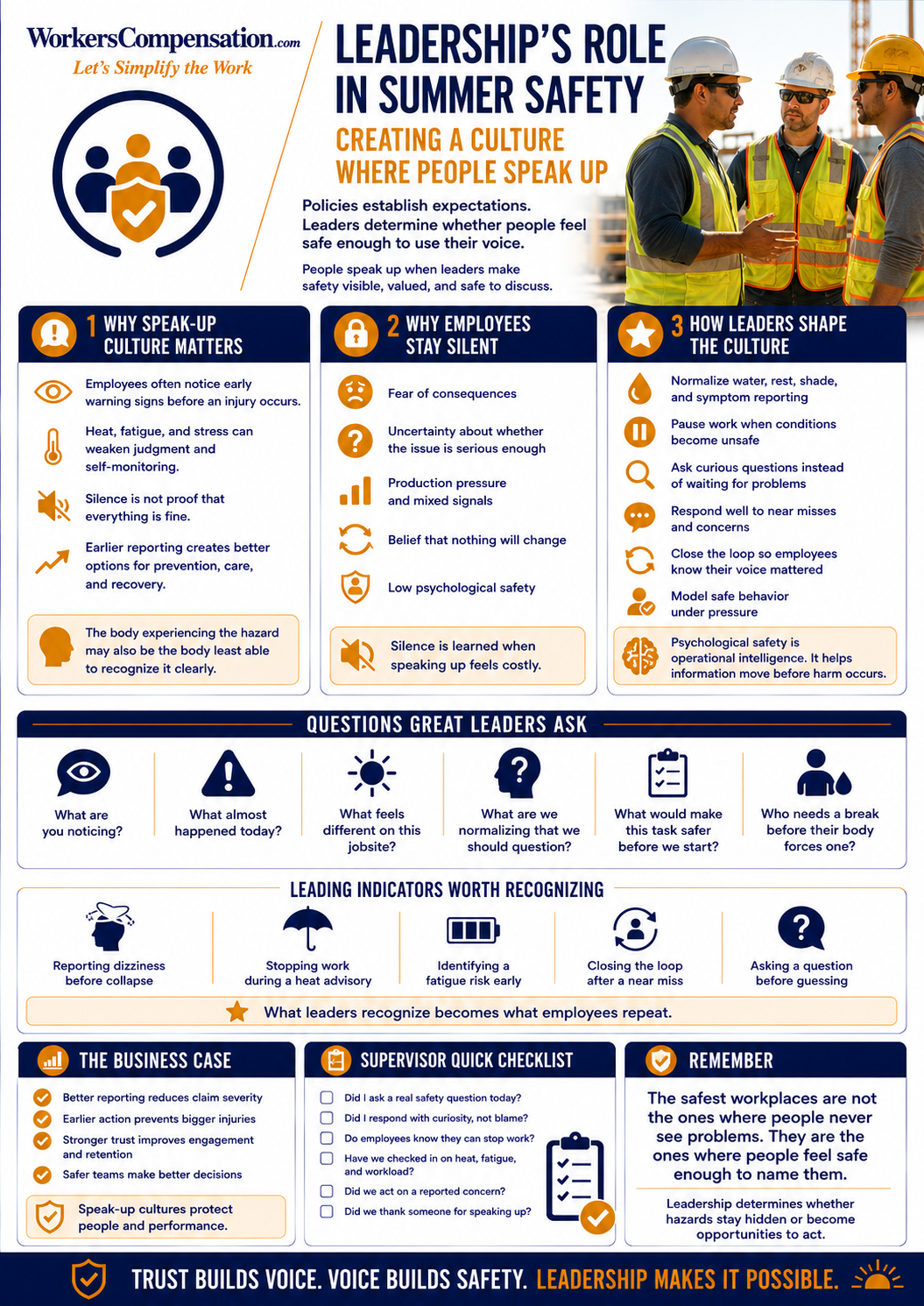
This is where leadership becomes a human performance intervention. A supervisor who normalizes water, rest, shade, and symptom reporting creates a different biological and psychological environment than one who praises endurance at any cost. A leader who pauses work during a heat advisory teaches employees that stopping for safety is not weakness. A leader who asks, “What are you noticing?” invites situational awareness. A leader who responds well to a near miss teaches the team that information is valuable. Employees rarely decide to speak up because they read a policy. They decide to speak up because of how a leader responded the last time someone did.
The behavioral science is clear. Employees stay silent for predictable reasons: fear of consequences, uncertainty about whether something is serious enough to report, production pressure, or the belief that nothing will change. National Safety Council survey data found workers who believed their employer discouraged reporting were more than twice as likely to have experienced a workplace injury. Silence is not proof that everything is fine. Sometimes silence is proof that people have learned the cost of speaking.
Psychological safety changes that pattern. Amy Edmondson's research demonstrates people are more likely to ask questions, admit mistakes, and report concerns when they believe they will not be embarrassed, punished, or ignored. In safety-sensitive work, that belief can determine whether a small concern becomes a conversation or a serious injury. Psychological safety is not softness. It is operational intelligence. It allows information to move before harm occurs.
Leadership also matters because middle managers and frontline supervisors often carry pressure from both directions. They are asked to maintain productivity while reinforcing safety. They are expected to meet schedules while protecting people. If supervisors do not feel safe escalating concerns, pausing work, or challenging unrealistic expectations, frontline employees will feel that tension immediately. A speak-up culture cannot exist for workers if it does not also exist for the leaders closest to the work.
The practical actions are simple, although not always easy. Leaders can ask better questions. What almost happened today? What feels different on this jobsite? What are we normalizing that we should be questioning? What would make this task safer before we start? Who needs a break before their body forces one? These questions do more than gather information. They teach employees what leadership values.
Recognition also matters. Organizations often celebrate zero injuries without asking whether zero reports reflect safety or silence. A stronger approach recognizes leading indicators: the employee who reports dizziness before collapse, the crew that stops work during a heat advisory, the driver who identifies a fatigue risk, the supervisor who closes the loop after a near miss, and the new worker who asks a question before guessing. What leaders recognize becomes what employees repeat.
Workers' compensation professionals understand the consequences when silence wins. Delayed reporting can increase claim severity, prolong recovery, and reduce trust. Heat-related symptoms that go unreported may evolve into more serious illness. Near misses that remain unspoken may become tomorrow's injury. A speak-up culture gives organizations earlier information, and earlier information creates better options for care, prevention, and recovery.
Technology can support this work, although it cannot replace leadership. Wearables, heat alerts, reporting apps, and predictive tools may identify risk earlier, but someone still has to act. A device can flag elevated strain. A supervisor must be willing to intervene. An app can collect a report. A leader must show that the report mattered. Technology strengthens safety when it is paired with trust.
Leadership's role in summer safety is not simply enforcing rules. It is shaping the conditions where people can tell the truth before the injury occurs. Leaders influence attention, stress, trust, reporting, learning, and recovery through the smallest daily behaviors. Every response teaches the workforce something. Every question opens or closes a door. Every moment of curiosity makes the workplace a little safer.
The safest organizations are not the ones where people never see problems. They are the ones where people feel safe enough to name them. Leadership determines whether hazards stay hidden or become opportunities to act. That is where prevention begins.
Tomorrow in The Science Behind Workplace Injuries - What 30 Days of Summer Safety Taught Us About Preventing Workplace Injuries. Over the past month, we explored heat, fatigue, storms, driving, noise, rushing, recovery, culture, and leadership. Tomorrow, we bring the full series together and examine what the science teaches us about preventing workplace injuries through biology, psychology, environment, and organizational systems.


AI best practices california case file caselaw case management case management focus claims compensability compliance compliance corner courts do you know the rule employers exclusive remedy florida fraud glossary check Healthcare hr homeroom insurance insurers iowa kentucky leadership NCCI new jersey new york ohio pennsylvania Safety safety at work state info tech technology the case manager violence WDYT what do you think women's history women's history month workers' comp 101 workers' recovery Workplace Safety Workplace Violence
Read Also
About The Author
About The Author
-
Claire Muselman
Meet Dr. Claire C. Muselman, the Chief Operating Officer at WorkersCompensation.com, where she blends her vast academic insight and professional innovation with a uniquely positive energy. As the President of DCM, Dr. Muselman is renowned for her dynamic approach that reshapes and energizes the workers' compensation industry. Dr. Muselman's academic credentials are as remarkable as her professional achievements. Holding a Doctor of Education in Organizational Leadership from Grand Canyon University, she specializes in employee engagement, human behavior, and the science of leadership. Her diverse background in educational leadership, public policy, political science, and dance epitomizes a multifaceted approach to leadership and learning. At Drake University, Dr. Muselman excels as an Assistant Professor of Practice and Co-Director of the Master of Science in Leadership Program. Her passion for teaching and commitment to innovative pedagogy demonstrate her dedication to cultivating future leaders in management, leadership, and business strategy. In the industry, Dr. Muselman actively contributes as an Ambassador for the Alliance of Women in Workers’ Compensation and plays key roles in organizations such as Kids Chance of Iowa, WorkCompBlitz, and the Claims and Litigation Management Alliance, underscoring her leadership and advocacy in workers’ compensation. A highly sought-after speaker, Dr. Muselman inspires professionals with her engaging talks on leadership, self-development, and risk management. Her philosophy of empathetic and emotionally intelligent leadership is at the heart of her message, encouraging innovation and progressive change in the industry. "Empowerment is key to progress. By nurturing today's professionals with empathy and intelligence, we're crafting tomorrow's leaders." - Dr. Claire C. Muselman
More by This Author
Read More
- Oct 19, 2026
- Claire Muselman
- Oct 19, 2026
- Anne Llewellyn
- Oct 19, 2026
- Chriss Swaney
- Oct 18, 2026
- Claire Muselman
- Oct 17, 2026
- Claire Muselman