


Share This Article:
Fall Into Safety
Welcome to The Science Behind Workplace Injuries: Fall Safety Series, where we explore how seasonal conditions interact with human physiology, behavior, and workplace systems. Yesterday, we examined autumn allergens and the performance effects associated with both symptoms and some common medications. Today, we move indoors, where colder temperatures quietly change the way buildings operate.
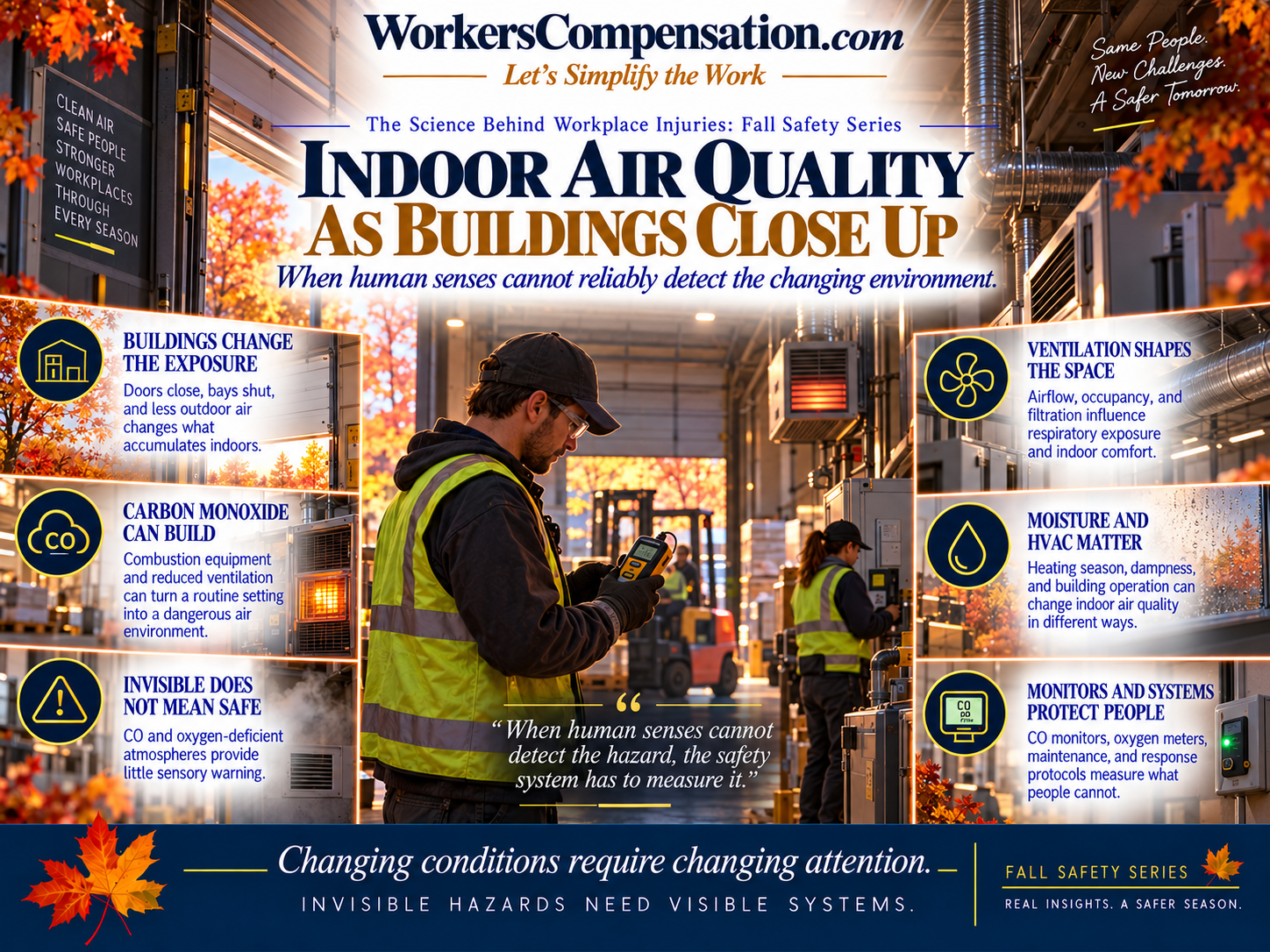
Doors and windows close. Warehouses stop leaving bays open. Construction sites become enclosed. Heating equipment returns to service, and temporary heaters appear in spaces that were naturally ventilated only weeks earlier. Vehicles, forklifts, generators, and combustion equipment may continue operating while the amount of outdoor air entering the workspace decreases. These changes alter the environment workers breathe and create conditions in which contaminants can accumulate.
Closing a Building Changes the Exposure
Carbon monoxide provides one of the clearest examples. Scott Henn and colleagues at NIOSH examined unintentional, non-fire occupational carbon monoxide fatalities in the United States from 1992 through 2008 and identified an average of approximately 22 deaths each year. Nearly 40% occurred during winter, and fatality rates were highest in the Midwest. Motor vehicles were the most common source, followed by heating systems and generators.
Carbon monoxide results from incomplete combustion, making the combination of combustion equipment and reduced ventilation particularly important as temperatures fall. An engine or heater operating safely in a well-ventilated environment can create a very different exposure when used inside a garage, warehouse, construction enclosure, or other restricted space. CO binds to hemoglobin with far greater affinity than oxygen, interfering with the body's ability to deliver oxygen to the brain, heart, and other tissues. Exposure can produce headache, dizziness, weakness, nausea, confusion, and fatigue before a worker recognizes an emergency.
The symptoms create another autumn problem: they are remarkably easy to misinterpret. Paul Heckerling evaluated 37 emergency-department patients presenting with headaches during the winter heating season and found seven, or 18.9%, had carboxyhemoglobin levels above 10%. Neither the patients nor their physicians had suspected carbon monoxide poisoning before testing revealed the exposure. In a workplace, a cluster of employees reporting headache, dizziness, nausea, unusual fatigue, or confusion in the same area should immediately raise an environmental question, particularly when combustion equipment is operating.
Human Senses Cannot Reliably Detect Dangerous Air
Many atmospheric hazards become dangerous precisely because workers receive little useful sensory warning. Carbon monoxide is colorless and odorless. Oxygen deficiency also provides no reliable odor or visual signal, and severe oxygen deprivation can cause rapid cognitive impairment, loss of coordination, unconsciousness, and death. A worker's ability to recognize the danger can therefore deteriorate along with the atmosphere.
Agriculture provides an especially important fall example. Controlled-atmosphere fruit-storage facilities intentionally maintain oxygen concentrations far below normal atmospheric levels to slow ripening. Silage fermentation creates a different hazard by producing nitrogen dioxide shortly after a silo is filled. The gas can accumulate at the silage surface and move into adjoining areas, exposing workers who never entered the silo itself. Respiratory effects can also be delayed, creating the possibility that a worker initially leaves the area without recognizing the seriousness of the exposure.
These hazards demonstrate why atmospheric monitoring matters. Human perception cannot substitute for calibrated CO monitors, oxygen meters, ventilation measurements, alarms, and appropriate confined-space testing. The same principle applies at lower levels of risk: occupants adapt quickly to odors and environmental conditions, making gradual deterioration difficult to judge from inside the space. When the hazard is invisible and perception is unreliable, objective measurement becomes part of the safety system.
Ventilation Affects More Than Acute Poisoning
Most employees will never encounter a severely oxygen-deficient atmosphere or occupational carbon monoxide poisoning. Millions, however, spend their working hours in offices, schools, health-care facilities, warehouses, and other buildings where ventilation changes with occupancy, weather, and building operation. Research in these environments connects ventilation with respiratory exposure, symptoms, absence, and some measures of cognitive performance, although the evidence does not establish that ordinary autumn indoor-air conditions increase workplace injury rates.
Donald Milton, P. Mark Glencross, and Michael Walters studied 3,720 employees across 40 buildings and found greater short-term sick leave among employees working in areas receiving less outdoor air. The researchers estimated that approximately 35% of short-term sick leave in the population they studied was attributable to the lower ventilation condition. The study was observational and involved one company, so the percentage should not be generalized to every workplace. The finding nevertheless illustrates that ventilation can have measurable organizational consequences beyond whether a room feels comfortable.
Carbon dioxide measurements can provide useful information here, but their meaning is frequently oversimplified. Xiaojing Zhang and colleagues experimentally separated the effects of CO2 from other contaminants produced by people in an occupied space. Pure CO2 concentrations up to 3,000 parts per million did not produce the same effects observed when ventilation was reduced and CO2 accumulated alongside human bioeffluents. In ordinary occupied buildings, elevated CO2 can therefore serve as a practical indicator of ventilation relative to occupancy without proving that CO2 itself is responsible for reported symptoms or cognitive effects.
The distinction is important for safety professionals because indoor-air conversations can quickly outrun the evidence. Poor ventilation can increase exposure to respiratory particles and other indoor contaminants, while moisture problems can support mold growth and combustion equipment can introduce far more serious hazards. Each condition requires the correct control. A CO2 reading, a mold concern, and a malfunctioning heater are all indoor-air issues, but they represent different exposures with different mechanisms and different levels of urgency.
Heating Season Deserves a Safety Changeover
Organizations routinely prepare equipment and operations for seasonal changes, and the indoor environment deserves the same attention. Before heating season is fully underway, permanent and temporary heating equipment should be inspected, combustion-powered equipment should be evaluated for excessive emissions, ventilation and exhaust systems should be confirmed operational, and CO and oxygen monitors should be tested and calibrated where needed. Gasoline-powered generators and similar combustion equipment belong outdoors, away from doors, windows, and air intakes. Work involving silos, controlled-atmosphere storage, and other potentially hazardous spaces requires atmospheric testing and established entry procedures before exposure occurs.
Seasonal preparation should also include the people expected to recognize an emerging problem. Supervisors need to know that multiple workers developing similar headaches, dizziness, nausea, confusion, or unusual fatigue can signal an environmental exposure. Employees working around combustion equipment should know where monitors are located, what alarms mean, and how to respond. Workers performing seasonal confined-space tasks need a refresher before the task returns to the schedule because procedures used infrequently are particularly vulnerable to memory decay.
Workers' compensation and incident investigations benefit from the same attention to environmental context. Acute carbon monoxide poisoning, oxygen-deficiency events, and silo-gas exposures may leave identifiable evidence, but environmental conditions can change quickly once equipment is shut down, doors are opened, or workers leave the area. Air-monitoring results, equipment-maintenance records, ventilation status, symptom timing, exposure location, and medical testing can become critical pieces of the causal picture. Capturing those details early improves both the investigation and the organization's ability to prevent another exposure.
Autumn changes more than the temperature outside. It changes ventilation, equipment use, occupancy patterns, combustion sources, and the movement of air through the places where people work. Some of the resulting hazards produce no smell, no visible warning, and no reliable sensation that tells a worker to leave. When human senses cannot reliably detect a changing environment, the safety system has to measure what people cannot.
Tomorrow in The Science Behind Workplace Injuries: Fall Safety Series — Harvest Season: One of America's Most Dangerous Times to Work. Agriculture carries one of the highest occupational fatality rates in the United States, and harvest changes the exposure profile through machinery, road travel, grain handling, long workdays, darkness, and intense production pressure.
Research Referenced
Heckerling, P. S. (1987). Occult carbon monoxide poisoning: A cause of winter headache. American Journal of Emergency Medicine, 5(3), 201–204. doi:10.1016/0735-6757(87)90320-2
Henn, S. A., Bell, J. L., Sussell, A. L., & Konda, S. (2013). Occupational carbon monoxide fatalities in the US from unintentional non-fire related exposures, 1992–2008. American Journal of Industrial Medicine, 56(11), 1280–1289. doi:10.1002/ajim.22226
Milton, D. K., Glencross, P. M., & Walters, M. D. (2000). Risk of sick leave associated with outdoor air supply rate, humidification, and occupant complaints. Indoor Air, 10(4), 212–221. doi:10.1034/j.1600-0668.2000.010004212.x
Zhang, X., Wargocki, P., Lian, Z., & Thyregod, C. (2017). Effects of exposure to carbon dioxide and bioeffluents on perceived air quality, self-assessed acute health symptoms, and cognitive performance. Indoor Air, 27(1), 47–64. doi:10.1111/ina.12284


AI best practices california case file caselaw case management case management focus claims compensability compliance compliance corner courts do you know the rule employers exclusive remedy florida fraud glossary check Healthcare hr homeroom insurance insurers iowa kentucky leadership NCCI new jersey new york ohio pennsylvania Safety safety at work state info tech technology the case manager violence WDYT what do you think women's history women's history month workers' comp 101 workers' recovery Workplace Safety Workplace Violence
Read Also
About The Author
About The Author
-
Claire Muselman
Meet Dr. Claire C. Muselman, the Chief Operating Officer at WorkersCompensation.com, where she blends her vast academic insight and professional innovation with a uniquely positive energy. As the President of DCM, Dr. Muselman is renowned for her dynamic approach that reshapes and energizes the workers' compensation industry. Dr. Muselman's academic credentials are as remarkable as her professional achievements. Holding a Doctor of Education in Organizational Leadership from Grand Canyon University, she specializes in employee engagement, human behavior, and the science of leadership. Her diverse background in educational leadership, public policy, political science, and dance epitomizes a multifaceted approach to leadership and learning. At Drake University, Dr. Muselman excels as an Assistant Professor of Practice and Co-Director of the Master of Science in Leadership Program. Her passion for teaching and commitment to innovative pedagogy demonstrate her dedication to cultivating future leaders in management, leadership, and business strategy. In the industry, Dr. Muselman actively contributes as an Ambassador for the Alliance of Women in Workers’ Compensation and plays key roles in organizations such as Kids Chance of Iowa, WorkCompBlitz, and the Claims and Litigation Management Alliance, underscoring her leadership and advocacy in workers’ compensation. A highly sought-after speaker, Dr. Muselman inspires professionals with her engaging talks on leadership, self-development, and risk management. Her philosophy of empathetic and emotionally intelligent leadership is at the heart of her message, encouraging innovation and progressive change in the industry. "Empowerment is key to progress. By nurturing today's professionals with empathy and intelligence, we're crafting tomorrow's leaders." - Dr. Claire C. Muselman
More by This Author
Read More
- Oct 23, 2026
- Claire Muselman
- Oct 21, 2026
- Claire Muselman
- Oct 21, 2026
- Frank Ferreri
- Oct 21, 2026
- Claire Muselman
- Oct 21, 2026
- Frank Ferreri
- Oct 20, 2026
- Claire Muselman