


Share This Article:
Conference Insights
Does how someone talks about an injury determine how well they recover from it?
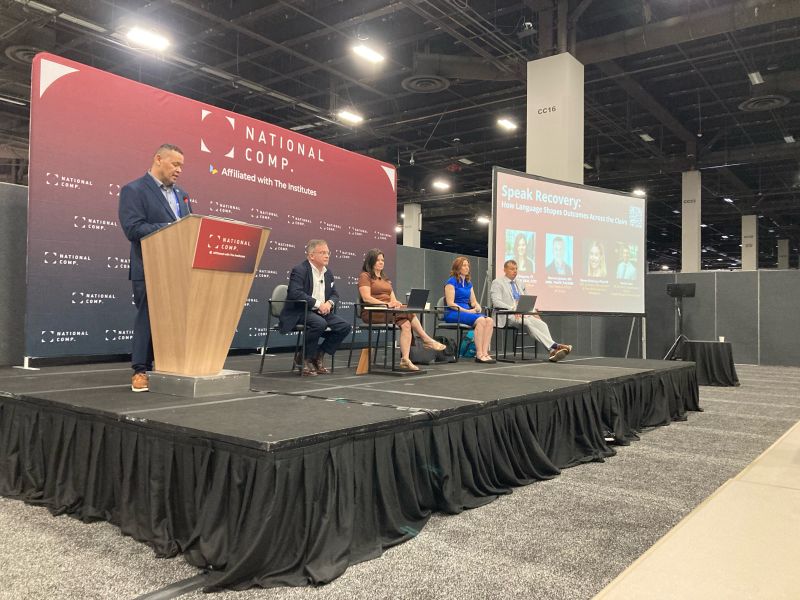
It's easy to say that words matter, but at National Comp, Hector Cano of Frank Winston Crum, Dr. Marcos Iglesias of AF Group, Dr. Devon Mahaney of Broadspire, and Michelle Despres of PhysNet analyzed practical ways showing how language can change the course of a workers' compensation claim.
Messages Everywhere
When someone gets hurt on the job, they're likely to hear all kinds of advice from all kinds of people.
"There's coworkers, family, supervisors, ads, stakeholders Dr. Google, Dr. ChatGPT," Iglesias said. "These aren't received as isolated messages."
According to Iglesias, it's important for stakeholders to understand: 1) communication is a form of therapy; and 2) injured workers are looking for meaning.
"They're not interested in the pieces, but they're trying to construct a story and figure out what does this mean to me?"
Cost of Well-intentioned Messages
One way the power of words in a claim shows up is when someone means well but sends the wrong message.
"We have every good intention when we tell the patient, 'Be careful,'" but it unintentionally signals that they have something to fear, Mahaney said.
Similarly, the "nocebo effect" occurs in a worker's recovery when their expectations are building negative thoughts in a cycle where behavior will match expectations, and expectations will drive behavior. Thus, a well-meaning "be careful" might turn into behavior that avoids activity.
Mahaney explained that the mistake is communicating to an injured person that movement involves pain, which prompts fear that activity will cause damage.
Despres said that the solution is a "therapeutic alliance" involving trust and empathy.
"An injured worker is angry, angry at life, angry at circumstances, so that makes shared goals important," Despres said. "On day 1, I talk to them about what we're going to do to get you well to get you back to work."
Despres noted that good communication with an injured worker is good business strategy because:
(1) Poor communication often is the main reason why a worker seeks an attorney.
(2) Fear of job loss adds four weeks of additional disability to the average claim.
(3) Physical therapy that starts in under 14 days leads to short claims duration.
(4) Physical therapy that starts within two days leads to a 50% shorter claim duration.
Similarly, Despres pointed out that tweaking questions can make a difference. For example:
(1) Instead of asking what's your pain 0-10, ask, "What are you able to do today?"
(2) Instead of asking, "Are you feeling better," ask "What activities have improved?"
(3) Instead of asking, "Does it still hurt," ask, "What function has returned?"
"The story influences the disability more than the diagnosis," Despres said. "That's what makes recovery-focused language so important because fear is a driving factor of so many things."
Some common messages in workers' comp might unintentionally tell an injured worker that their prospects don't look good. For example, saying, "Your MRI looks bad" could make an injured worker think, "I'm damaged." Likewise, "stay off work" sounds like "work is dangerous," and "don't lift anything" communicates "movement is harmful."
'You're not Facing it Alone'
Cano noted that recovering from a workplace injury is difficult, but the key is to let injured workers know that they can do hard things and that they have people on their side.
"Claims become complicated, not because of the injury, they become complicated because of the conversations that happen after," Cano said. "Not everything is sunshine and rainbows, sometimes you have to go through pain, but it's central to recovery."
What can help?
"Sometimes you have to give them shorter goals," Cano said. "And you have to let them know recovery is possible, and you're not facing it alone."
Despres explained that helpful communication needs to start right away in a claim, and everyone involved needs to be on the same page.
"The earliest interaction sets the stage," she said. "And messaging must be aligned across the claims team because with every interaction, there's a choice; will it be more helpful, or will it be more fearful, and the answer to that depends on how you choose your words."
Mahaney shared the example of a friend who was a marathon runner and experienced a knee injury. She faced psychological challenges and was struggling in her recovery efforts due to sleepless nights caused by muscle cramping that kept her up. Eventually, she took muscle relaxers for three days, and returning to a normal sleep pattern helped restart her recovery.
"That's what gave her the boost to get her back on her way," Mahaney said.
With injured workers, it's similarly important to find where the "boost" might come from.
"I do psychological screening," Despres said. "What worries you most about your injury? What concerns you most about going back to work? Do you think movement helps recovery?"
Asking those questions and working with the answers can help shape expectations for a worker and change the direction of a claim.
"The individual who expects to get better will get better," Iglesias said.


AI best practices california case file caselaw case management case management focus claims compensability compliance compliance corner courts do you know the rule employers exclusive remedy florida fraud glossary check Healthcare hr homeroom insurance insurers iowa kentucky leadership NCCI new jersey new york ohio pennsylvania Safety safety at work state info tech technology the case manager violence WDYT what do you think women's history women's history month workers' comp 101 workers' recovery Workplace Safety Workplace Violence
Read Also
About The Author
About The Author
-
Frank Ferreri
Frank Ferreri, M.A., J.D. covers workers' compensation legal issues. He has published books, articles, and other material on multiple areas of employment, insurance, and disability law. Frank received his master's degree from the University of South Florida and juris doctor from the University of Florida Levin College of Law. Frank encourages everyone to consider helping out the Kind Souls Foundation and Kids' Chance of America.
More by This Author
- Oct 24, 2026
- Frank Ferreri
- Oct 21, 2026
- Frank Ferreri
Read More
- Oct 25, 2026
- Claire Muselman
- Oct 25, 2026
- Chris Parker
- Oct 24, 2026
- Claire Muselman
- Oct 24, 2026
- Frank Ferreri
- Oct 24, 2026
- Claire Muselman
- Oct 23, 2026
- Claire Muselman