


Share This Article:
Summer Safety Series
Welcome to The Science Behind Workplace Injuries: 30 Days of Summer Safety, where we explore the environmental hazards, human physiology, behavioral science, and organizational decisions shaping workplace safety. This article is part of our July series examining the science behind workplace injuries and the factors influencing workplace safety during the summer months.
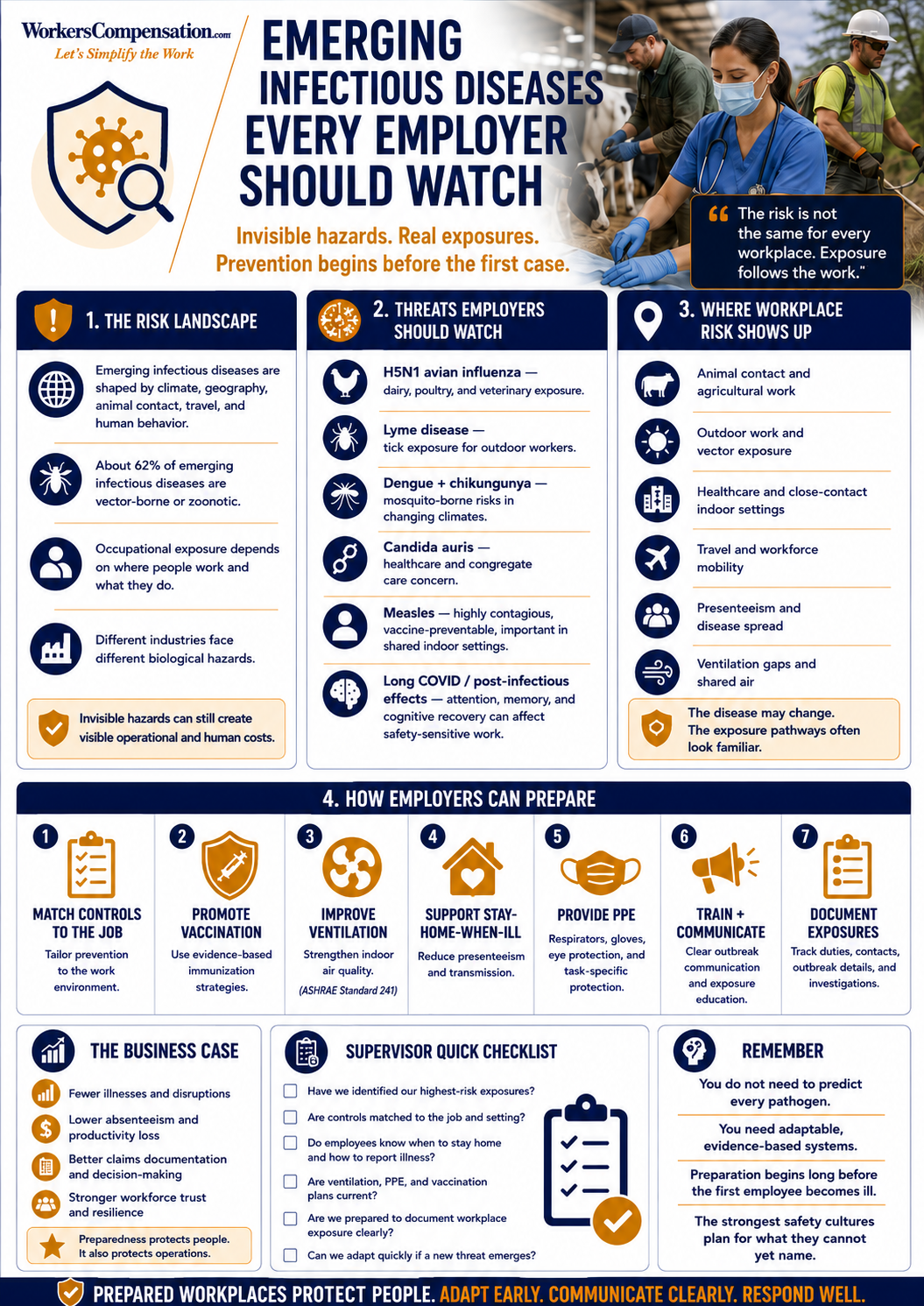
When most people hear the words emerging infectious disease, they think about the next pandemic. Occupational health professionals ask a different question. Which employees are most likely to encounter the next emerging disease first? The answer depends on where people work. Dairy workers, poultry producers, veterinarians, landscapers, utility crews, construction workers, healthcare professionals, first responders, educators, and employees who travel frequently all experience different patterns of occupational exposure. Emerging infectious diseases are rarely random workplace events. They follow predictable pathways shaped by climate, geography, animal contact, travel, and human behavior.
A comprehensive 2025 review published in BMC Infectious Diseases concluded that emerging infectious diseases are an ongoing consequence of an increasingly interconnected world. Researchers found vector-borne and zoonotic diseases accounted for approximately sixty-two percent of emerging infectious diseases, highlighting the growing importance of outdoor work, animal exposure, and environmental change. For employers, understanding occupational exposure has become just as important as understanding the diseases themselves.
Several infectious disease threats deserve particular attention today. Highly pathogenic H5N1 avian influenza remains an important concern for dairy operations, poultry producers, veterinarians, and others working directly with animals. Climate change continues expanding the geographic range of ticks and mosquitoes, increasing occupational exposure to Lyme disease, dengue, and chikungunya for many outdoor workers. Healthcare organizations continue addressing the spread of the drug-resistant fungus Candida auris, while resurgent diseases such as measles remind employers that vaccine-preventable illnesses remain an important workplace consideration. The specific pathogens differ. The underlying lesson remains remarkably consistent. Occupational exposure reflects where people work and what they do every day.
One of the most significant changes since the COVID-19 pandemic involves the regulatory landscape. Temporary workers' compensation presumptions have largely expired, OSHA withdrew its proposed Infectious Diseases standard, and employers have returned to relying primarily on the General Duty Clause along with existing standards addressing respiratory protection, bloodborne pathogens, and personal protective equipment. Prevention has become even more important because organizations can no longer assume emergency regulatory frameworks will guide every future outbreak.
The science also reminds us infectious diseases influence more than physical health. Researchers studying Long COVID continue documenting measurable changes in attention, processing speed, executive function, and memory among some individuals following infection. Other infectious diseases, including severe Lyme disease and certain mosquito-borne illnesses, may also affect the nervous system. For employees operating vehicles, heavy equipment, or performing other safety-sensitive work, understanding recovery sometimes extends beyond resolving the infection itself. Human performance remains part of the conversation.
Behavior often becomes the deciding factor in workplace disease transmission. Researchers estimate presenteeism, or coming to work while ill, costs U.S. employers billions of dollars annually through reduced productivity, lower performance, and increased disease transmission. Surveys suggest many employees continue working despite having paid sick leave because of workload expectations, concerns about coworkers, or organizational culture. The greatest barrier is often not biology. It is the pressure people feel to be present when recovery would better protect both themselves and those around them.
Leadership therefore becomes one of the strongest tools for preventing occupational disease. Organizations that encourage employees to stay home when they are ill, communicate clearly during outbreaks, promote vaccination, improve ventilation, and provide appropriate personal protective equipment create multiple layers of protection before exposure occurs. The American Society of Heating, Refrigerating and Air-Conditioning Engineers (ASHRAE) developed Standard 241 to improve indoor air quality during periods of increased infectious disease risk, reinforcing that engineering controls remain one of the most effective ways to reduce airborne transmission. Prevention rarely depends on one intervention alone. It succeeds through multiple layers working together.
Outdoor industries require a different approach. Tick prevention programs, insect repellents, protective clothing, vegetation management, hydration, heat management, and employee education all reduce the likelihood of exposure to vector-borne diseases. Agricultural operations similarly benefit from eye protection, respiratory protection, and safe work practices when employees work with poultry, dairy cattle, or other animals that may carry zoonotic diseases. The objective is not eliminating every risk. It is matching prevention strategies to the realities of the work environment.
Workers' compensation professionals are also returning to familiar principles. With many COVID-19 presumptions having expired, compensability once again depends largely on demonstrating that occupational exposure exceeded the risk experienced by the general public. Thorough documentation of workplace exposures, job duties, outbreak investigations, and employee activities becomes increasingly important when determining whether an infectious disease arose out of employment. Understanding the work environment often becomes just as important as understanding the diagnosis itself.
One of the most encouraging developments is that infectious disease preparedness continues improving even as specific threats evolve. Wastewater surveillance, genomic sequencing, predictive modeling, improved ventilation strategies, and stronger occupational health programs allow public health professionals and employers to identify emerging risks earlier than ever before. The names of the diseases will continue changing. The scientific principles guiding prevention remain remarkably consistent.
Workplace safety includes the invisible biological hazards that travel through the air, move with changing climates, or cross from animals to humans. Organizations do not need to predict every future pathogen. They need systems that are adaptable, evidence-based, and prepared to respond when new risks emerge. The strongest safety cultures understand preparation begins long before the first employee becomes ill.
Tomorrow in The Science Behind Workplace Injuries - Noise Exposure During Peak Construction Season. Noise is often treated as a hearing problem. Neuroscience tells a much bigger story. Tomorrow, we explore how excessive noise influences attention, communication, fatigue, cognitive performance, and workplace safety long before permanent hearing loss develops.


AI best practices california case file caselaw case management case management focus claims compensability compliance compliance corner courts do you know the rule employers exclusive remedy florida fraud glossary check Healthcare hr homeroom insurance insurers iowa kentucky leadership NCCI new jersey new york ohio pennsylvania Safety safety at work state info tech technology the case manager violence WDYT what do you think women's history women's history month workers' comp 101 workers' recovery Workplace Safety Workplace Violence
Read Also
About The Author
About The Author
-
Claire Muselman
Meet Dr. Claire C. Muselman, the Chief Operating Officer at WorkersCompensation.com, where she blends her vast academic insight and professional innovation with a uniquely positive energy. As the President of DCM, Dr. Muselman is renowned for her dynamic approach that reshapes and energizes the workers' compensation industry. Dr. Muselman's academic credentials are as remarkable as her professional achievements. Holding a Doctor of Education in Organizational Leadership from Grand Canyon University, she specializes in employee engagement, human behavior, and the science of leadership. Her diverse background in educational leadership, public policy, political science, and dance epitomizes a multifaceted approach to leadership and learning. At Drake University, Dr. Muselman excels as an Assistant Professor of Practice and Co-Director of the Master of Science in Leadership Program. Her passion for teaching and commitment to innovative pedagogy demonstrate her dedication to cultivating future leaders in management, leadership, and business strategy. In the industry, Dr. Muselman actively contributes as an Ambassador for the Alliance of Women in Workers’ Compensation and plays key roles in organizations such as Kids Chance of Iowa, WorkCompBlitz, and the Claims and Litigation Management Alliance, underscoring her leadership and advocacy in workers’ compensation. A highly sought-after speaker, Dr. Muselman inspires professionals with her engaging talks on leadership, self-development, and risk management. Her philosophy of empathetic and emotionally intelligent leadership is at the heart of her message, encouraging innovation and progressive change in the industry. "Empowerment is key to progress. By nurturing today's professionals with empathy and intelligence, we're crafting tomorrow's leaders." - Dr. Claire C. Muselman
More by This Author
Read More
- Oct 14, 2026
- Claire Muselman
- Oct 14, 2026
- Frank Ferreri
- Oct 13, 2026
- Claire Muselman
- Oct 13, 2026
- Frank Ferreri
- Oct 12, 2026
- Claire Muselman
- Oct 12, 2026
- Anne Llewellyn