


Share This Article:
Checklist Charlie
Texas Workers' Compensation: Unique Features Checklist
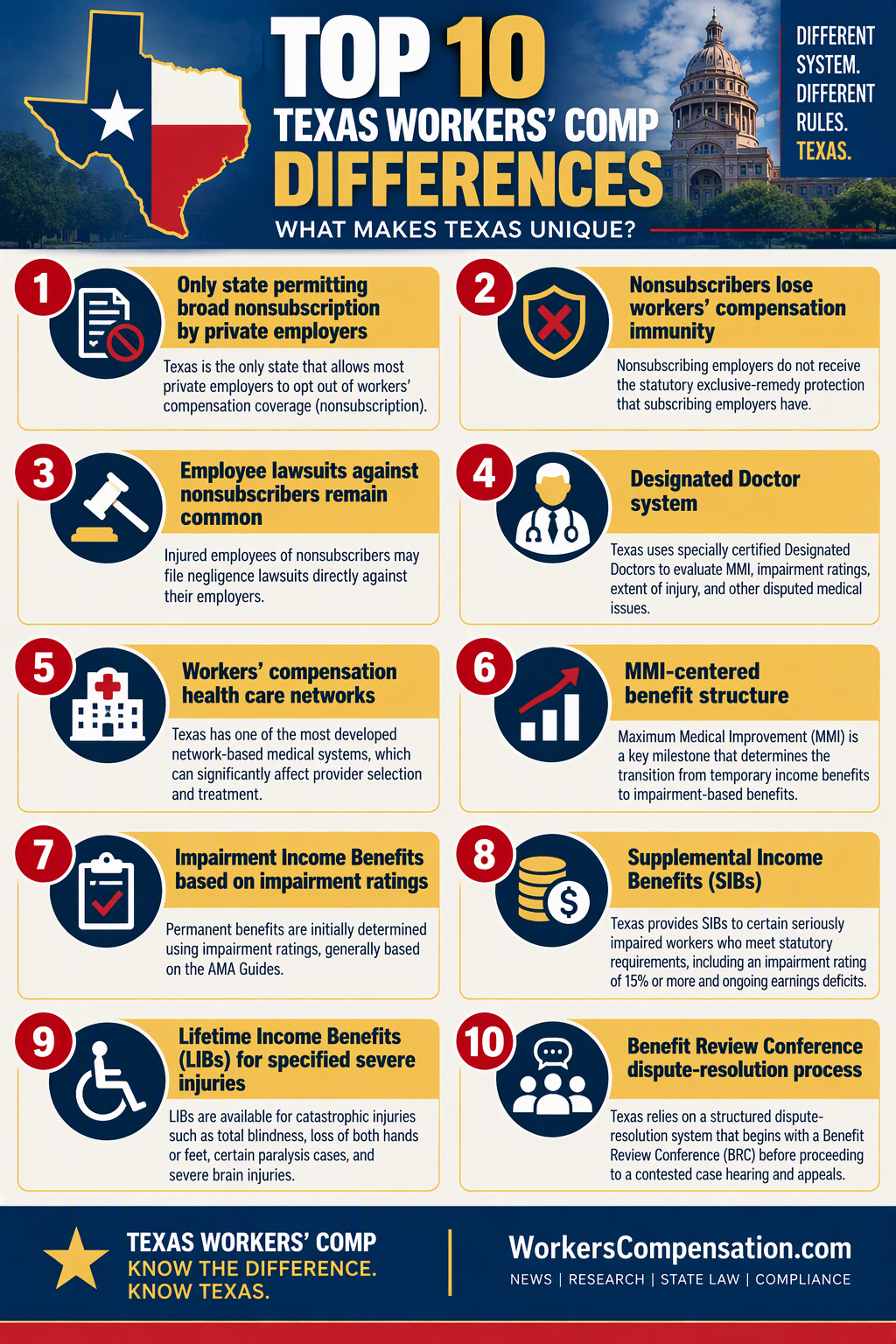
Texas is the most unusual workers' compensation jurisdiction in the United States. Many of its defining characteristics either do not exist elsewhere or are significantly different from the systems used in most states.
Use this checklist when evaluating Texas-specific issues.
Employer Coverage
✅ Texas Allows Private Employers to Opt Out of Workers' Compensation
Texas is the only state that permits most private employers to completely decline participation in the workers' compensation system ("nonsubscription").
Key Points:
- Employers may become "nonsubscribers."
- Nonsubscribers lose certain legal protections.
- Injured workers may sue nonsubscribers directly.
- Traditional workers' compensation immunity does not apply.
Why Unique: Every other state requires private employers to maintain workers' compensation coverage, subject to limited exceptions.
✅ Nonsubscriber Employers Lose Common-Law Defenses
When sued by an employee, a Texas nonsubscriber generally cannot rely on:
- Assumption of risk
- Fellow-servant doctrine
- Contributory negligence (subject to statutory nuances)
Why Unique: Most states never face this issue because employers cannot opt out.
Administrative Structure
✅ Texas Uses the Division of Workers' Compensation (DWC)
Agency:
- Texas Department of Insurance (TDI)
- Division of Workers' Compensation (DWC)
Why Notable: Texas workers' compensation operates within the insurance department rather than as a stand-alone workers' compensation commission.
Medical Treatment
✅ Extensive Use of Certified Health Care Networks
Texas has one of the most developed workers' compensation health care network systems.
Key Points:
- Certified workers' compensation networks may direct care.
- Employee choice rules differ depending on network participation.
- Network enrollment dramatically affects provider selection.
Why Unique: Texas relies on managed-care concepts more heavily than many states.
✅ Designated Doctor Program
Texas uses specially certified "Designated Doctors."
The DWC may appoint a Designated Doctor to evaluate:
- Maximum Medical Improvement (MMI)
- Impairment Rating (IR)
- Extent of injury
- Disability issues
- Return-to-work disputes
Why Unique: Although independent medical examinations exist nationwide, Texas gives Designated Doctors unusually influential statutory authority.
Impairment and Permanent Disability
✅ Permanent Benefits Tied Directly to Impairment Ratings
Texas uses:
- MMI
- Whole-person impairment ratings
Ratings are generally based on the AMA Guides.
Impairment Income Benefits (IIBs) are paid according to impairment percentage.
Example:
Plain Text
1% impairment = 3 weeks of IIBs
Why Unique: Many states use disability concepts rather than heavily formulaic impairment schedules.
✅ No Traditional Permanent Partial Disability Structure
Texas does not use the common model found in many states:
Plain Text
Temporary Total
Permanent Partial
Permanent Total
Instead, benefits progress through:
- Temporary Income Benefits (TIBs)
- Impairment Income Benefits (IIBs)
- Supplemental Income Benefits (SIBs)
- Lifetime Income Benefits (LIBs)
Why Unique: This framework differs substantially from the terminology and benefit structures used elsewhere.
Supplemental Income Benefits (SIBs)
✅ Supplemental Income Benefits (SIBs)
Texas provides SIBs to certain seriously impaired workers.
Requirements generally include:
- Significant impairment rating
- Demonstrated work search efforts
- Ongoing earnings deficits
Why Unique: Few states have a benefit category operating quite like Texas SIBs.
Lifetime Income Benefits
✅ Lifetime Income Benefits Limited to Extreme Injuries
Examples include:
- Total blindness
- Loss of both feet
- Loss of both hands
- Severe brain injuries
- Certain paralysis cases
Why Unique: Eligibility standards are exceptionally specific and statutorily defined.
Dispute Resolution
✅ Benefit Review Conferences (BRCs)
Texas heavily relies on:
- Benefit Review Conference
- Contested Case Hearing
- Appeals process
Why Unique: The procedural framework is distinctive and highly structured compared to many jurisdictions.
✅ Administrative Appeals Before Court Involvement
Most disputes proceed through DWC administrative channels before judicial review.
Why Notable: Texas places significant emphasis on agency dispute resolution.
Medical Cost Control
✅ Strong Medical Fee Guideline System
Texas employs detailed reimbursement methodologies and utilization controls.
Includes:
- Medical fee guidelines
- Utilization review
- Preauthorization requirements
Why Unique: Texas has historically been one of the more aggressive states in medical cost-containment efforts.
Return-to-Work
✅ Temporary Income Benefits End at MMI
Once a worker reaches Maximum Medical Improvement:
- Temporary Income Benefits stop.
- The claim transitions to impairment-based benefits.
Why Unique: The transition point plays a larger role than in many states.
First Responder Presumptions
✅ Extensive Presumptions for Certain First Responders
Texas has enacted important presumptions involving:
- Firefighters
- Peace officers
- Emergency personnel
Including:
- Certain cancers
- PTSD-related claims
- Line-of-duty conditions
Why Notable: Recent legislative expansions have increased protections for first responders.
Quick Reference: "Texas-Only" Checklist
| Feature | Texas Distinction |
|---|---|
| Employer Opt-Out | ✅ Only state allowing broad nonsubscription |
| Nonsubscriber Lawsuits | ✅ Employees may sue employer directly |
| Loss of Traditional Defenses | ✅ Nonsubscribers lose major defenses |
| Designated Doctors | ✅ Unusually powerful statutory role |
| Certified WC Networks | ✅ Extensive managed-care structure |
| Supplemental Income Benefits | ✅ Relatively unique benefit category |
| Lifetime Income Benefits | ✅ Highly specific qualifying injuries |
| Benefit Review Conferences | ✅ Core dispute-resolution process |
| MMI-Driven Benefit System | ✅ Strong emphasis on MMI and impairment |
| Alternative Benefit Structure | ✅ TIBs, IIBs, SIBs, LIBs instead of traditional PPD/PTD |
Bottom Line
The single most important thing that distinguishes Texas from every other jurisdiction is nonsubscription. No other state allows private employers generally to opt out of workers' compensation coverage while operating under a separate liability framework. Beyond that, Texas's Designated Doctor system, impairment-driven benefit structure, Supplemental Income Benefits, and extensive network-based medical system make it one of the most distinctive workers' compensation systems in the country.
Bonus Reading
✅ Exclusive Remedy Protection Exists Only for Subscribers
A subscribing employer generally receives statutory exclusive-remedy protection from employee lawsuits. A nonsubscriber does not receive that immunity. This distinction is one of the most important practical features of Texas workers' compensation. [tcss.legis.texas.gov]
✅ Texas Statutory MMI Rules
Texas is unusual in having highly detailed statutory MMI provisions and timelines, including certification procedures and impairment-rating disputes. [texas.public.law]
✅ Benefit Review Conferences (BRCs)
Your discussion of Benefit Review Conferences is accurate. They remain a foundational component of the Texas dispute-resolution process administered by the Division of Workers' Compensation. [tdi.texas.gov], [texas.public.law]


AI best practices california case file caselaw case management case management focus claims compensability compliance compliance corner courts do you know the rule employers exclusive remedy florida fraud glossary check Healthcare hr homeroom insurance insurers iowa kentucky leadership NCCI new jersey new york ohio pennsylvania Safety safety at work state info tech technology the case manager violence WDYT what do you think women's history women's history month workers' comp 101 workers' recovery Workplace Safety Workplace Violence
Read Also
About The Author
About The Author
- WorkersCompensation.com
More by This Author
- Nov 19, 2026
- WorkersCompensation.com
- Nov 18, 2026
- WorkersCompensation.com
- Nov 16, 2026
- WorkersCompensation.com
Read More
- Nov 19, 2026
- NCCI
- Nov 19, 2026
- WorkersCompensation.com
- Nov 18, 2026
- WorkersCompensation.com
- Nov 16, 2026
- WorkersCompensation.com
- Nov 13, 2026
- WorkersCompensation.com
- Nov 12, 2026
- Evan Swan