


Share This Article:
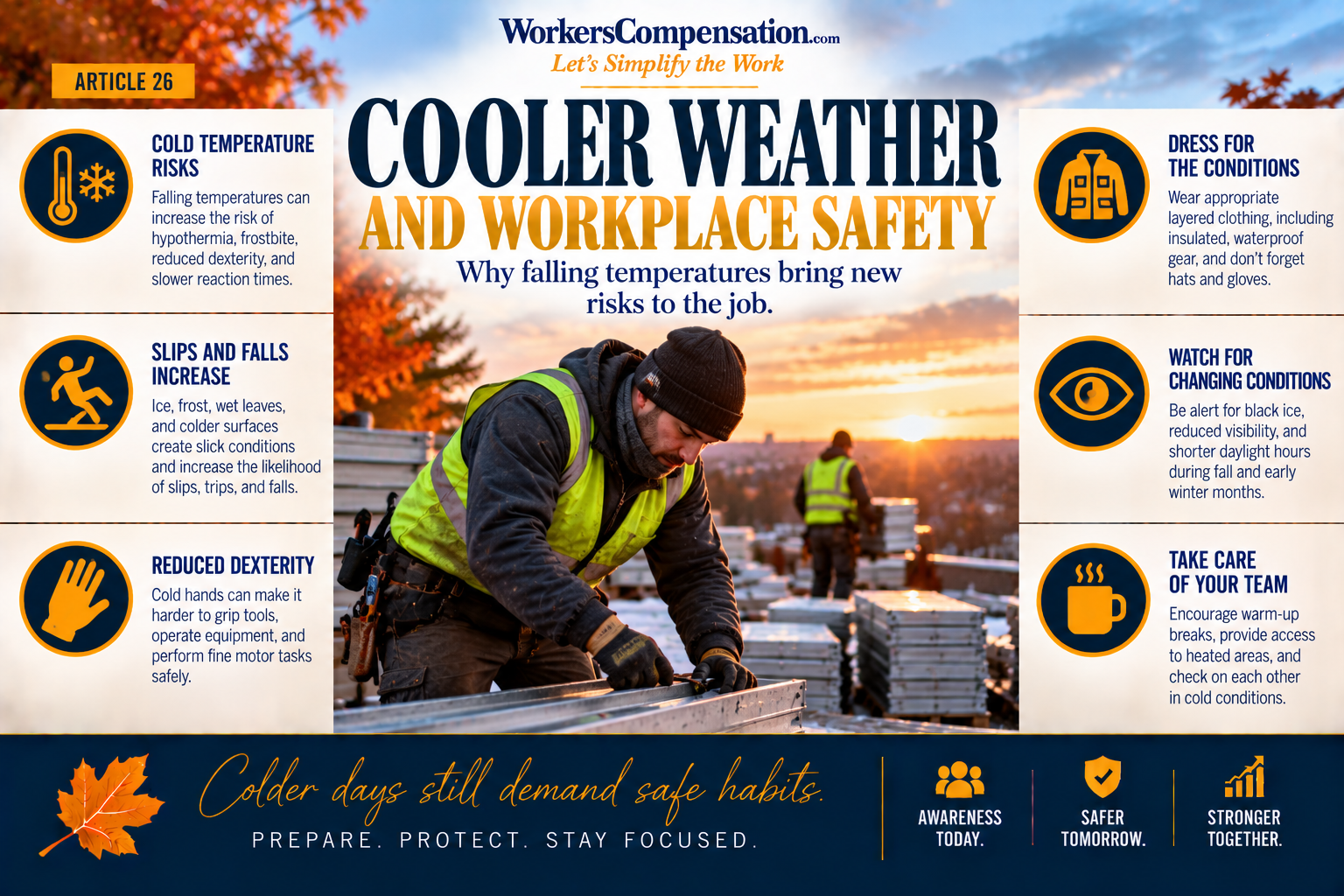
Fall Into Safety
Welcome to The Science Behind Workplace Injuries: Fall Safety Series, where we explore how seasonal conditions interact with human physiology, behavior, and workplace systems. Yesterday, we examined how seasonal changes in light can affect a vulnerable minority while darkness changes the physical environment for everyone. Temperature creates another transition that begins earlier than many people expect. Cold-related performance changes do not require a blizzard, subzero temperatures, or obvious cold stress. Hands, muscles, balance, and attention can begin responding while conditions still feel like ordinary autumn weather. The body notices the temperature transition before the season earns the label of winter.
The Body Protects the Core First
Human thermoregulation follows a hierarchy. As the body begins losing heat, blood vessels near the skin constrict, reducing peripheral blood flow so more heat can be preserved around vital organs. That response protects core temperature while allowing the hands, feet, and skin to cool. Ronald Heus, Hein Daanen, and George Havenith reviewed the physiological requirements for hand function in cold environments and identified approximately 15°C, or 59°F, as an important minimum skin-temperature criterion for maintaining manual performance. The number is a guideline rather than a biological switch, but the pattern is consistent: dexterity, tactile sensitivity, nerve conduction, and muscular function deteriorate as the hands cool. A worker can therefore feel reasonably comfortable overall while the fingers responsible for gripping a ladder, controlling a tool, manipulating a fastener, or holding a handrail are already functioning differently.
Muscle temperature matters as well. Sébastien Racinais and Juha Oksa reviewed research on temperature and neuromuscular function and found short-duration muscle performance changes by roughly 2% to 5% for each degree Celsius of muscle-temperature change. Cooler muscle contracts differently, produces force more slowly, and can fatigue sooner. Rate of force development becomes particularly important when something unexpected happens because recovering from a slip, catching a shifting load, or stabilizing the body requires force quickly. Cooler weather therefore changes more than comfort. It can quietly reduce the physical reserve available when routine movement suddenly becomes corrective movement.
Balance Can Change at 50 Degrees
Moderate cold can also influence postural control. Tiina Mäkinen and colleagues exposed participants to air temperatures of 10°C, or 50°F, and measured changes in balance. Compared with warmer conditions, cold exposure substantially increased multiple measures of postural sway. The study included only ten participants, so its exact percentages should not be treated as universal thresholds, but the direction of the effect remained across repeated exposures. Participants adapted somewhat with experience while the difference between warm and cold conditions persisted.
That finding matters for autumn because 50°F rarely feels like a serious occupational temperature. Workers may be on roofs, ladders, loading docks, construction sites, agricultural equipment, or uneven terrain without thinking of themselves as performing “cold work.” Add rain or wet clothing and the thermal equation changes again. Water accelerates heat loss, and occupational guidance recognizes that cold-related conditions can occur well above freezing when workers remain wet. Autumn creates combinations of moderate cold, wind, rain, damp clothing, and physical work that can alter performance long before anyone begins worrying about hypothermia.
The Brain Changes Movement When It Expects Trouble
Cooler weather also changes the surfaces beneath workers, and human behavior responds differently when the brain expects a hazard. Rakie Cham and Mark Redfern studied how people walked when they anticipated a slippery floor. Simply expecting reduced friction changed their gait: participants shortened their strides, reduced heel velocity, and made flatter foot contact, decreasing peak friction demands by approximately 16% to 33%. The body already possesses strategies for walking more safely on questionable surfaces. The brain has to recognize the need to use them.
That creates a particular problem during seasonal transitions. A parking lot covered in obvious snow communicates danger immediately. The first patch of frost on an otherwise familiar walkway may not. Wet leaves, black ice, shaded entrances, loading areas, and freeze-thaw conditions can change friction without producing the visual cues people associate with winter. Ice near its melting point can also be especially slippery because a thin water layer reduces friction. The first cold mornings can therefore create a mismatch between the environment and the movement pattern a worker brings into it. Specific information about conditions gives the brain an opportunity to adapt before the first step lands.
Seasonal Preparation Should Protect Capacity
Organizations have several opportunities to address the transition without asking employees to overcome physiology through effort. Gloves can be selected for both thermal protection and the dexterity required by the task. Warm and dry break areas can limit cumulative cooling. Outdoor work can be scheduled during warmer portions of the day when feasible, while surface treatment can be timed to employee arrival instead of waiting until after people have already crossed the hazard. Appropriate footwear matters as well. Research on workplace slip prevention has shown that providing effective slip-resistant footwear can reduce injury claims, reinforcing a broader principle: equipment works better when organizations make the safer option readily available.
The timing of communication matters, too. A generic winter-safety reminder sent in December misses part of the problem because physical and environmental changes begin earlier. The first frost, cold rain, dark evening, or freeze-thaw morning deserves specific attention precisely because workers have not yet adapted their expectations to the new conditions. Familiar routes and tasks can create confidence based on yesterday's environment. Autumn changes that environment incrementally, often before the change feels significant.
Cooler weather does not suddenly make people careless or incapable. Human physiology responds normally to changing thermal conditions, sometimes before conscious discomfort provides a useful warning. Hands cool, muscles lose some capacity, balance can change, and the surfaces supporting movement become less predictable. Prevention becomes stronger when organizations recognize those changes before workers have to discover them through performance. When capacity can decline before awareness catches up, the safety system has to respond to the conditions instead of waiting for the person to feel the difference.
Tomorrow in The Science Behind Workplace Injuries: Fall Safety Series — Fatigue During Fourth Quarter. We will examine how year-end workload, accumulated demands, sleep, recovery, and sustained cognitive effort can change the capacity workers bring to the final months of the year.
Research Referenced
Cham, R., & Redfern, M. S. (2002). Changes in gait when anticipating slippery floors. Gait & Posture, 15(2), 159–171.
Heus, R., Daanen, H. A. M., & Havenith, G. (1995). Physiological criteria for functioning of hands in the cold. Applied Ergonomics, 26(1), 5–13.
Mäkinen, T. M., Rintamäki, H., Korpelainen, J. T., Kampman, V., Pääkkönen, T., Oksa, J., Palinkas, L. A., Leppäluoto, J., & Hassi, J. (2005). Postural sway during single and repeated cold exposures. Aviation, Space, and Environmental Medicine, 76(10), 947–953.
Racinais, S., & Oksa, J. (2010). Temperature and neuromuscular function. Scandinavian Journal of Medicine & Science in Sports, 20(Suppl. 3), 1–18.


AI best practices california case file caselaw case management case management focus claims compensability compliance compliance corner courts do you know the rule employers exclusive remedy florida fraud glossary check Healthcare hr homeroom insurance insurers iowa kentucky leadership NCCI new jersey new york ohio pennsylvania Safety safety at work state info tech technology the case manager violence WDYT what do you think women's history women's history month workers' comp 101 workers' recovery Workplace Safety Workplace Violence
Read Also
About The Author
About The Author
-
Claire Muselman
Meet Dr. Claire C. Muselman, the Chief Operating Officer at WorkersCompensation.com, where she blends her vast academic insight and professional innovation with a uniquely positive energy. As the President of DCM, Dr. Muselman is renowned for her dynamic approach that reshapes and energizes the workers' compensation industry. Dr. Muselman's academic credentials are as remarkable as her professional achievements. Holding a Doctor of Education in Organizational Leadership from Grand Canyon University, she specializes in employee engagement, human behavior, and the science of leadership. Her diverse background in educational leadership, public policy, political science, and dance epitomizes a multifaceted approach to leadership and learning. At Drake University, Dr. Muselman excels as an Assistant Professor of Practice and Co-Director of the Master of Science in Leadership Program. Her passion for teaching and commitment to innovative pedagogy demonstrate her dedication to cultivating future leaders in management, leadership, and business strategy. In the industry, Dr. Muselman actively contributes as an Ambassador for the Alliance of Women in Workers’ Compensation and plays key roles in organizations such as Kids Chance of Iowa, WorkCompBlitz, and the Claims and Litigation Management Alliance, underscoring her leadership and advocacy in workers’ compensation. A highly sought-after speaker, Dr. Muselman inspires professionals with her engaging talks on leadership, self-development, and risk management. Her philosophy of empathetic and emotionally intelligent leadership is at the heart of her message, encouraging innovation and progressive change in the industry. "Empowerment is key to progress. By nurturing today's professionals with empathy and intelligence, we're crafting tomorrow's leaders." - Dr. Claire C. Muselman
More by This Author
Read More
- Oct 17, 2026
- Frank Ferreri
- Oct 16, 2026
- Claire Muselman
- Oct 14, 2026
- Claire Muselman
- Oct 14, 2026
- Frank Ferreri
- Oct 13, 2026
- Claire Muselman
- Oct 13, 2026
- Frank Ferreri