


Share This Article:
July Update: This Month, Don’t Miss These 3 Key Updates in Workers’ Comp Pharmacy
26 Jul, 2026 Dennis Sponer
July 2026
Three developments this month are worth noting for every workers’ compensation pharmacy professional and payer. Texas is taking a proactive step that other states should watch closely—and it has now opened a comment window that closes August 6. The federal government just released results that should end a long-standing debate over managed care pharmacy. And West Virginia passed a spread pricing ban with a structural quirk that will have unintended consequences for workers’ comp payers in that state. Plus, a few brief observations regarding Mississippi and Arizona to consider during this hot summer.
Texas Targets Topicals—A Spreading Problem in Comp
The Texas Division of Workers’ Compensation has approved its 2026 Medical Quality Review Annual Audit Plan, which selects topical analgesics as the sole subject of a plan-based medical quality audit. The audit will review the medical necessity and appropriateness of topical analgesic prescribing across the Texas workers’ compensation system, including compliance with the Official Disability Guidelines adopted by the DWC. DWC will also review peer utilization review reports to confirm that the reviewing providers followed those guidelines and were appropriately credentialed.
This month, the audit went from announcement to execution. In July, the DWC released a draft of the topical analgesic plan-based audit and asked system participants to weigh in on how the audit should be structured—including the time frame, sample size, and case selection criteria. Comments to the DWC’s Office of the Medical Advisor (OMA@tdi.texas.gov) are due by 5 p.m. Central time on August 6, 2026. Payers, PBMs, and utilization review agents armed with Texas data on topical prescribing patterns have a short window of opportunity to shape what the audit measures and where it looks.
Here are two reasons why this issue matters beyond Texas.
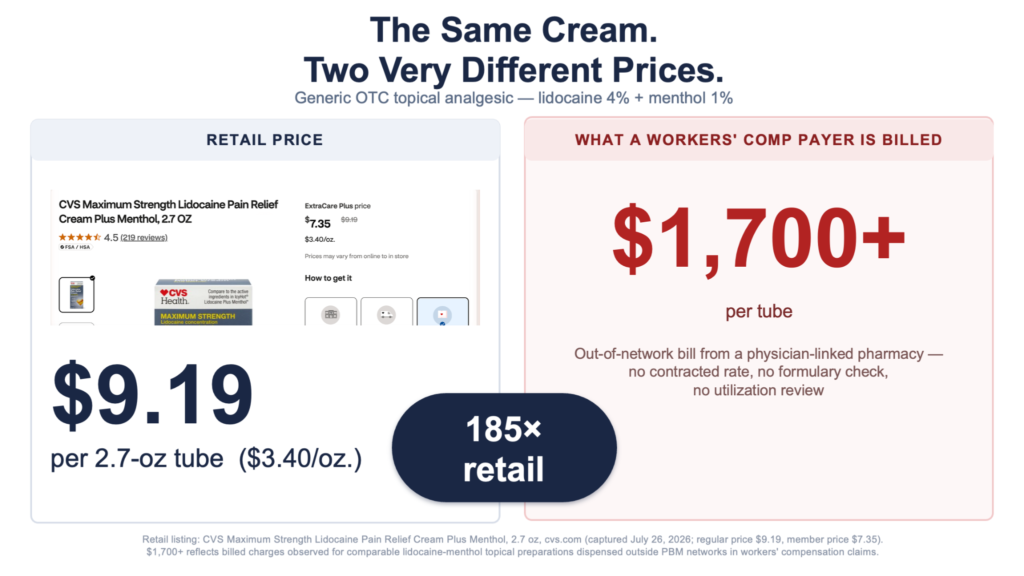
Topicals are the fastest-growing cost driver in workers’ comp pharmacy nationally. Costs per claim for topical medications rose 96% from 2012 to 2023, nearly doubling in a decade, NCCI data shows. That growth wasn’t based on clinical evidence. It was driven by a lack of controls. Topicals dispensed by physicians and compounded topical preparations almost completely bypass PBM networks, formulary review and utilization management. This situation has resulted in a category where a generic, over-the-counter product with lidocaine and menthol can cost a carrier more than $1,700 per tube, while the same product costs just over $9 at CVS.
The second is that Texas is opting for audit over legislation, and that’s an important distinction. The DWC is laying the analytical groundwork up front—documenting prescribing patterns, identifying outliers, measuring the medical necessity gap, and then acting, rather than waiting for a fee schedule fight or a court decision. The DWC has already stated that audit results could be used to inform future changes to reimbursement rules where systemwide trends and compliance gaps warrant them. This is a model for other states, and it shows that Texas regulators understand the issue well enough to make it an audit priority.
This audit presents risk and opportunity for payers, PBMs, and TPAs with Texas exposure. If your book has led to an increase in the use of topical analgesics, the DWC is now looking closely at it. If your PBM and utilization review processes already have clinical controls for this category, now is your chance to clearly document that—and, before August 6, to do so in the comment process.
Federal Government Builds Case for Managed Care Pharmacy
The Department of Labor’s Office of Workers’ Compensation Programs said in May that it is extending pharmacy benefit improvements under the Federal Employees’ Compensation Act program to claimants covered by the Black Lung Benefits Act, the Longshore and Harbor Workers’ Compensation Act, and the Energy Employees Occupational Illness Compensation Program Act.
Buried within that announcement was a data point that deserves far more attention than it got: The OWCP pharmacy program reduced annual drug expenditures from $226.2 million in calendar year 2018 to $39.8 million in calendar year 2025—an 82.4% reduction over seven years while maintaining quality care for injured workers.
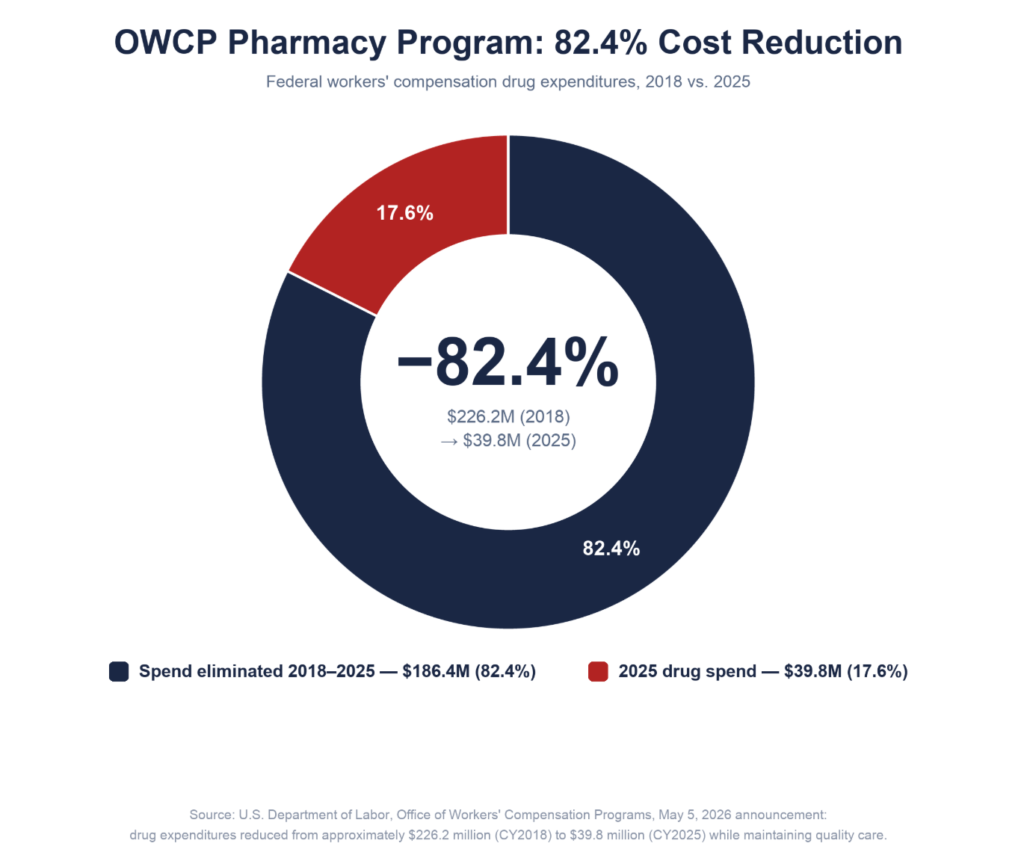
This was accomplished through enhanced clinical management, rigorous oversight of the pharmacy benefit administrator, direct formulary management, and data-driven waste, fraud, and abuse prevention. In other words, managed pharmacy was consistently applied with an institutional commitment—with measurable results.
The workers’ comp industry has long debated whether the managed care tools that work in commercial health insurance translate to the WC context. The OWCP result documents actual program outcomes reported by a federal agency managing a large and diverse population of injured workers over a sustained period. The program achieved those savings while maintaining quality care for injured workers.
The 82.4% cost reduction is hard to argue against if the claim is that workers’ comp pharmacy can’t be managed effectively. We have all heard the arguments—that the patient population is too complex, the injuries too variable, and the system too fragmented.
States that continue to prohibit pharmacy network steering, resist formulary adoption, or decline to apply clinical controls to high-cost categories such as topicals and compounds are choosing a higher-cost outcome—with no systemwide benefits. The OWCP data makes self-evident what the obvious proper path should be.
West Virginia’s Spread Pricing Ban — Good Idea, Complicated Execution
West Virginia Governor Patrick Morrisey signed HB 5430 on April 1, 2026, making West Virginia one of the first states to use the National Average Drug Acquisition Cost as an explicit ceiling on what a PBM may charge a payer—regardless of what the underlying contract says. If there is a NADAC price for a drug, the PBM cannot bill the payer more than the NADAC price for the drug cost portion of the claim. When NADAC is not available, the PBM may not bill more than what it paid the dispensing pharmacy. The law’s definition of “third party” specifically includes prescription drugs under workers’ compensation insurance coverage. It is not a commercial-health-only statute.
The goal is simple: to end spread pricing, the practice by which a PBM charges a payer more than it pays the pharmacy and retains the difference—sometimes without disclosing it. Spread pricing can be a real problem when there is a lack of transparency, and West Virginia’s approach is among the most direct attempts any state has made to eliminate it.
The wrinkle is that West Virginia already has a provision on the books that mandates PBMs reimburse in-state pharmacies at no less than the NADAC plus a $10.49 dispensing fee — a mandatory reimbursement floor that applies regardless of negotiated contract rates. When that floor is combined with HB 5430’s new ceiling, PBMs are caught in a structural bind: they are required to pay pharmacies at NADAC plus $10.49, but in some cases they may not be able to charge the payer enough to recover those costs without exceeding the NADAC cap on the billing side.
This pattern recurs when broad commercial health PBM legislation applies to workers’ compensation without accounting for WC’s distinct regulatory structure. The commercial health framework assumes a different reimbursement architecture with cost-sharing, rebate flows, and pricing dynamics that do not map cleanly onto WC pharmacy. The result in West Virginia is a well-meaning law that may raise costs for workers’ comp payers in ways the legislature did not intend. Payors and PBMs with West Virginia exposure should review their contract structures now, before the full impact of the provision becomes apparent at the claim level.
To be clear, none of this is an argument against PBMs. Lost in the rush to regulate is a basic fact: PBMs perform real work, and that work has real value. A workers' comp PBM builds and maintains the pharmacy networks that let an injured worker fill a prescription at tens of thousands of retail locations on day one, without paying out of pocket. It adjudicates claims in real time at the point of sale, applies formularies and clinical edits, screens for dangerous drug interactions and opioid stacking, reviews bills against state fee schedules, manages utilization of high-risk and high-cost medications, and pays pharmacies promptly so they keep serving injured workers. For payers, that converts a chaotic stream of paper bills into managed, reviewable transactions; for injured workers, it converts coverage into access. A PBM that delivers that service deserves compensation for it. The legitimate demand—the one legislatures should be making—is not that PBMs work for free but that they be transparent about how they are paid: disclose the pricing methodology, disclose the spread or replace it with a stated administrative fee, and let the payer judge whether the value justifies the cost.
Bonus: Topicals are in the crosshairs everywhere – Arizona, Mississippi and Alaska
Arizona’s Industrial Commission published a new Physicians’ and Pharmaceutical Fee Schedule that took effect on May 1, 2026 and once again topicals are the story. The Commission raised the reimbursement cap for topical compounded medications from $200 to $240 for a 30-day supply — a 20% increase. The update also included over-the-counter medications in the section of the fee schedule that deals with conditions for coverage of medications dispensed by a health care provider or a pharmacy not open to the general public and added language requiring pharmacies to obtain the lowest AWP version of a medication when there is more than one manufacturer of that medication. The Commission has indicated additional language regarding prescription topicals will be coming later this year; the fee schedule is effective through April 30, 2027.
Meanwhile, Mississippi is closing a loophole it accidentally created. When the state updated its medical fee schedule effective June 1, 2026, it inadvertently dropped the language capping reimbursement for manufactured, non-compounded topical medications. Stakeholders pointed out the omission, and the state issued a formal notice of correction June 29, reinstating the cap—a billed charge up to a maximum of $30 for a 30-day supply—with an amendment date of Sept. 1, 2026. The speed of the fix is telling: when a topical reimbursement cap disappears, the industry notices within weeks. The Medical Services Review Committee of the Alaska Workers’ Compensation Division spent its summer meetings reviewing physician dispensing and compounded, topical and repackaged medications as part of a possible update to the fee schedule, with more meetings scheduled through August.
The Common Denominator: Out-of-Network Pharmacy Bills
Stepping back from the individual developments, a pattern emerges. The $1,700 tube of topical analgesic won't be coming through a PBM network. It is an out-of-network bill from a dispensing physician, a physician-linked pharmacy, or a third-party biller, with no contracted rate, dispensed without a formulary check, and paid without a utilization review touchpoint. That’s the path of just about every high-cost anomaly in workers’ comp pharmacy. Out-of-network bills are a small fraction of prescriptions in most states, but they make up a disproportionate share of cost, disputes, and regulatory attention—which is why Texas is auditing topicals, why the OWCP invested in managing every pharmacy transaction it pays, and why fee schedule drafters in Arizona, Mississippi, and Alaska keep circling back to the same drug categories.
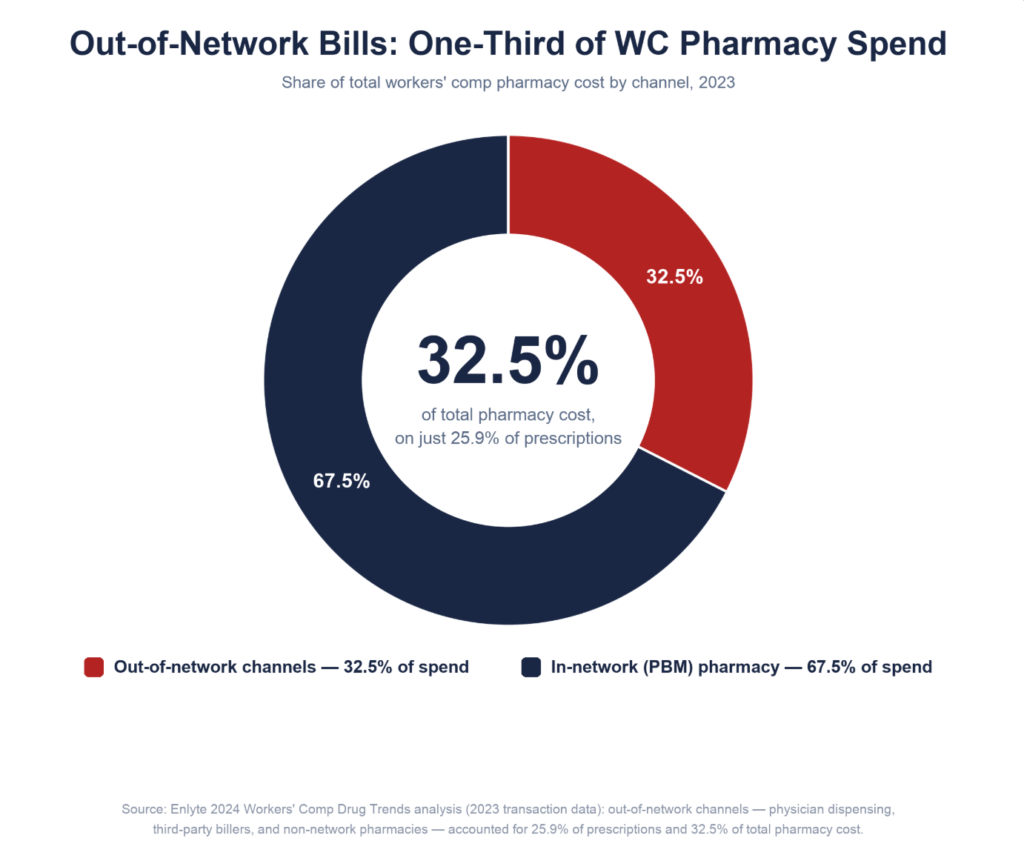
This area is also where I have been concentrating my efforts this year. I’ve been reviewing out-of-network workers’ comp pharmacy bills with my colleagues on the clinical and pharmacy side, jurisdiction by jurisdiction—what's really in the bills, how the prices are constructed, and what each state’s statutes and fee schedules really permit a payer to do about them. There are two observations from that work worth sharing. First, the pricing on these bills rarely complies with the state's own rules. Second, most payers pay them anyway, because the bills land outside the systems built to examine them. The gulf between those two facts is one of the largest unaddressed cost problems in workers’ comp pharmacy — and as the developments above suggest, regulators are starting to take notice.
All of these developments point in one direction: workers’ compensation pharmacy costs do not manage themselves, and the systems that deliver the best results are those in which regulators and payers are actively applying clinical and financial controls. Texas is doing the audit and taking comments until August 6. The federal government has just proved that the managed care pharmacy model works. West Virginia's trying. The execution can be messy, but they are working to address the problem. Meanwhile, Arizona, Mississippi and Alaska are tightening their grip on the same drug category. The path forward is encouraging.
Dennis M. Sponer, J.D., LL.M., MBA, is the founder of SRX Advisors, a regulatory intelligence and consulting firm that helps PBMs and payers control pharmacy costs in workers' compensation. Dennis founded and served as CEO of two PBMs, one of which, ScripNet, focused exclusively on managing workers' comp pharmacy costs across all fifty states. He also serves as Of Counsel at Goldsand Friedberg, a health care regulatory law firm. This season, he will be presenting on workers’ comp pharmacy cost issues at the RIMS Texas Regional Conference in San Antonio (August 10-12), the Elevate Work Comp Conference in San Diego (September 21-23) and National Comp in Las Vegas (September 29-October 1).


AI best practices california case file caselaw case management case management focus claims compensability compliance compliance corner courts do you know the rule employers exclusive remedy florida fraud glossary check Healthcare hr homeroom insurance insurers iowa kentucky leadership NCCI new jersey new york ohio pennsylvania Safety safety at work state info tech technology the case manager violence WDYT what do you think women's history women's history month workers' comp 101 workers' recovery Workplace Safety Workplace Violence
Read Also
About The Author
About The Author
- Dennis Sponer
More by This Author
Read More
- Sep 27, 2026
- Dennis Sponer
- Sep 27, 2026
- WorkersCompensation.com
- Sep 26, 2026
- Niki Moore Simmons
- Sep 24, 2026
- CJ Cypcar
- Sep 24, 2026
- Saroar Hossain
- Sep 19, 2026
- WorkersCompensation.com