


Share This Article:
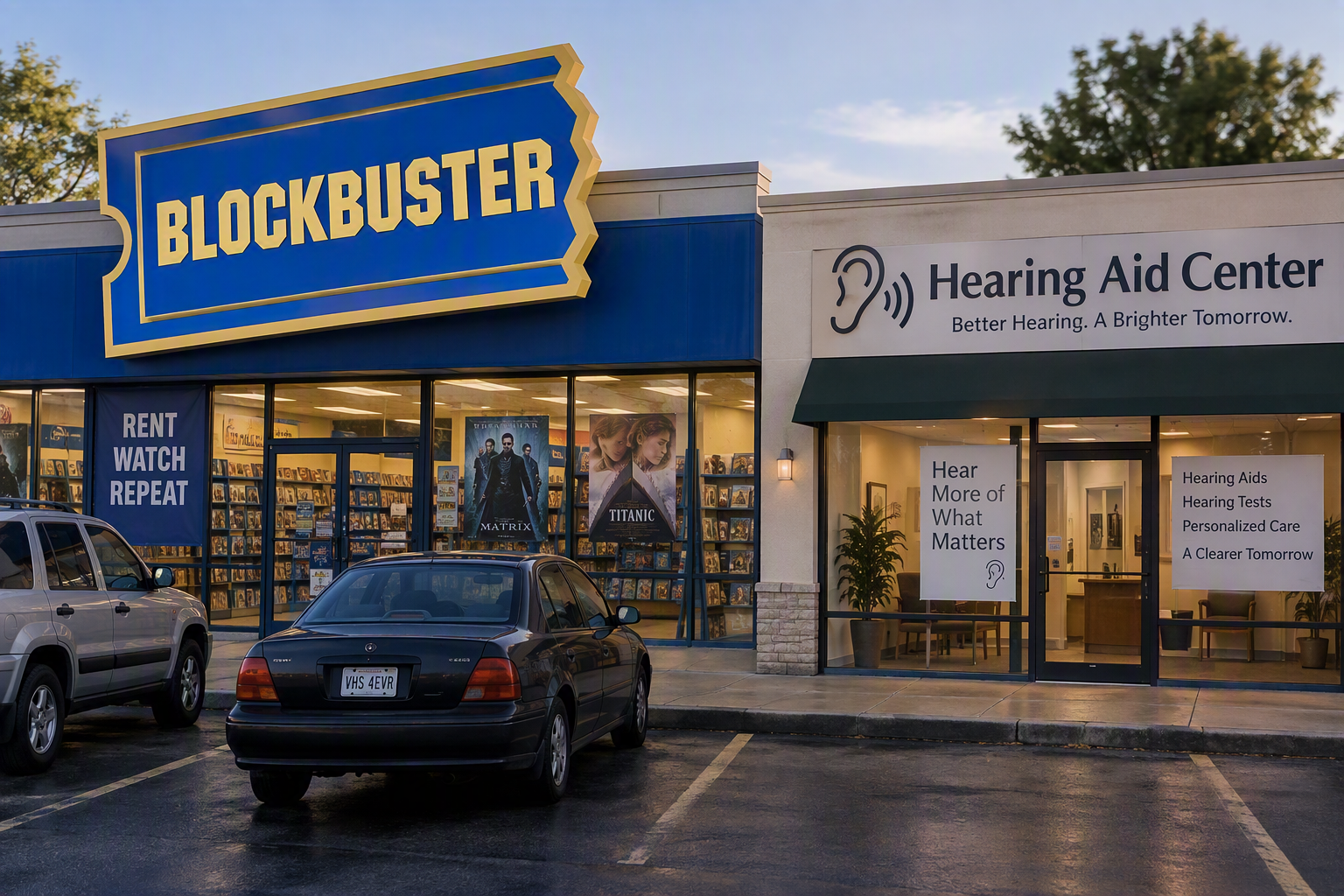
Remember when Blockbuster was the latest and greatest thing?
The blue-and-yellow sign. Friday night. Walking the New Releases wall with your family, negotiating over what to rent. If you wanted to watch a movie at home, that was simply how it was done. There was no other way, and nobody was asking for one.
For nineteen years, that was a winning business. Blockbuster grew from a single store in 1985 into a chain of roughly 9,000 locations worldwide, peaking in 2004. Then the floor went out. Between 2003 and 2005, the company lost more than 75% of its market value. By 2010 it was in bankruptcy.
Here's the part that still makes people wince. In 2000, before any of that, two founders of a small DVD-by-mail startup flew to Dallas and offered to sell their company to Blockbuster for $50 million. Blockbuster's leadership passed. The startup was a niche business, they reasoned, serving a narrow slice of customers who would never represent the mainstream.
That startup was Netflix.
It wasn't the technology. It was the model.
It's tempting to say Blockbuster lost because it missed streaming. But streaming didn't exist yet in 2000. What Blockbuster actually missed was something simpler, and it was sitting in its own financial statements.
Blockbuster's model required thousands of physical storefronts. Every one of those stores carried rent, payroll, inventory, utilities, and management overhead costs that had to be paid whether anyone walked through the door. All of that expense got baked into the price of a rental and into the late fees customers resented paying.
And the model made the customer do the work. You drove to the store. You went during store hours. You hunted through the shelves, hoping the thing you wanted hadn't already been checked out. Then you drove back to return it.
Blockbuster's leadership looked at that friction and saw a moat. Customers assumed it was just the price of admission. Both were wrong. Convenience wasn't a feature customers were asking for by name. It was a need they didn't know could be met until someone met it.
Now think about how most people still get fit for hearing aids.
This isn't an abstract consumer problem. Hearing loss is one of the most common work-related illnesses in the United States. According to CDC, roughly 22 million workers are exposed to hazardous noise on the job every year, and a 2023 NIOSH study estimated that U.S. workers' compensation systems handle roughly 5,000 occupational hearing loss claims a year, at about $60 million annually in 2013 dollars. NIOSH also notes that those figures understate the true burden, because most occupational hearing loss is never compensated at all. Mining, construction, and manufacturing carry the heaviest toll, but plenty of moderate-noise jobs produce claims too. Once hearing loss is documented and connected to the job, a hearing aid often becomes something an employer's workers' comp carrier is on the hook to cover for the rest of the injured worker's life.
So, a worker files a claim. What happens next looks a lot like Blockbuster's New Releases wall.
Imagine you are the injured worker. Your adjuster finds a clinic and calls to schedule an appointment, often weeks out. You take time off work, or you use a day of the leave you're already burning through because of the injury. You sit in a waiting room. You get a hearing test. And then, often, you go home without a device because hearing aids aren't a product you pull off a shelf. They generally need to be selected and fitted to your specific hearing loss.
So, you schedule a second appointment. You go back. And when something isn't quite right, the sound is too sharp, the fit is uncomfortable, you're struggling to hear over machinery or in meetings, you schedule a third. And a fourth. Each adjustment is another appointment, another trip, another day away from work or family, on top of an injury you didn't ask for in the first place.
On the claims side, every one of those appointments keeps the file open, and an open file isn't free. It carries adjuster time, reserves that must be set and revisited, bill review, scheduling, and follow-up with the clinic, all before the worker has a device that works for them. Then there are the hard costs. Carriers generally reimburse injured workers for mileage to and from authorized medical appointments. In states that follow the IRS rate, that's 76 cents a mile as of July 2026, and some claims also pay for transportation services when a worker can't drive. A 40-mile round trip, repeated over four visits, is more than $120 in mileage alone. Each visit that pulls the worker off the job can also add wage-loss benefits, depending on the state, on top of what the employer spends covering the missed shift. On a single claim, none of these line items looks large. Across a book of hundreds of hearing loss claims, each staying open for months, they add up quickly. Hearing loss claims are already prone to dispute: the loss builds gradually, overlaps with normal age-related change, and is often claimed years after the exposure. The longer a file sits, the more likely an attorney gets involved. One industry analysis found that 70% of attorneys enter a workers' comp claim more than a month after the first report of injury, often over disputes about medical care, and that represented claims take 2.1 times longer to close and cost 2.3 times more. A 2024 WCRI study of nearly a million claims found attorney involvement adds $7,700 to $12,400 in payments and increases expense payments by 200%.
Meanwhile, every one of those visits is happening inside a physical clinic that carries rent, payroll, and overhead much like the storefronts that weighed Blockbuster down. The person doing the fitting in these clinics may be an audiologist or a licensed hearing aid specialist. Hearing aid specialists handle a large share of hearing aid dispensing in the U.S. They are trained and licensed specifically to test hearing, fit devices, and fine-tune them, often with years of hands-on experience. Audiologists hold a graduate-level clinical degree and cover a broader range of hearing care. Both are skilled professionals. The issue isn't who does the fitting. It's the model built around it: the scheduling, the repeat trips, and the overhead.
None of this is because the people running these clinics are careless. It's that the appointment-based, storefront-first model was built for an era with fewer alternatives. The building is not expertise. The drive is not the care.
The regulatory door opened, too.
This shift isn't just a business idea. It now has federal backing. In August 2022, the FDA finalized a rule creating a category of over-the-counter (OTC) hearing aids for adults with perceived mild to moderate hearing loss, letting people buy certain devices without a medical exam, a prescription, or an in-person fitting. The rule took effect that October. The FDA's own reasoning was that cost and access were the biggest barriers keeping most of the roughly 30 million Americans who could benefit from hearing aids from using them and that cutting out unnecessary steps in the process could help close that gap. Audicus doesn't sell off-the-shelf OTC devices, but the rule is a clear signal of where hearing care is heading, and why a blended model that pairs remote convenience with professional oversight makes sense.
That's the same argument this article has been making about Blockbuster, just with a federal agency's signature on it.
What changes with a telehealth model.
Audicus was built on a straightforward question: which parts of this process require a person to be in a room, and which parts are just inherited habit?
The answer turned out to be most of it. With a telehealth model, you take a hearing test online, or you send in an audiogram you already have. A hearing professional reviews your results and recommends a device. Your hearing aids are custom programmed to your hearing loss before they ship so when the box arrives at your door, they're already tuned to you. No first appointment. No second appointment to pick them up.
And when you need an adjustment, you don't have to travel anywhere. Remote care lets a specialist fine-tune your programming from wherever you are, depending on the device. That matters more than it might seem. Hearing aid problems rarely show up in a quiet exam room. They show up on a noisy shop floor or in an echoing restaurant. In the traditional model, the fix happens back at the clinic, in the one setting where the problem can't be reproduced. Remote adjustments let the device be tuned for the environment where the worker actually struggles. Support doesn't end at the point of sale.
Audicus provides comprehensive lifetime of device follow-up care. From setup in the first days, through regular check-ins during the first year, to annual reviews and a replacement device at three years, the team is there at every stage to make sure the hearing aids keep working for the worker. All at no cost to the file until time for replacement, then we start over again. Same service, same commitment.
For the worker, that means ten scheduled touchpoints over three years without a single trip to a clinic. For the adjuster, it means a predictable care path instead of an open-ended string of appointments.
The cost difference isn't a discount or a promotion. It reflects what tends to happen when a company isn't carrying the cost of a large retail footprint: less of the price goes to overhead, and that can bring the total down meaningfully compared with the traditional in-clinic path without changing the underlying technology or the professional review behind it. For a worker going through a comp claim, that gap can matter just as much as the convenience does.
The lesson Blockbuster couldn't learn in time.
The executives in that Dallas conference room in 2000 weren't stupid. They were successful. That was precisely the problem. When your current model is working, every alternative looks like a niche serving a handful of unusual customers.
But "niche" is often just what a better model looks like before it becomes obvious. The mail-order DVD wasn't a worse video store. It was a different answer to the same question: how do I get this thing into a person's hands with the least friction possible?
For a worker already dealing with the fallout of an occupational injury, lost wages, a comp claim, time away from the job, that friction isn't just an inconvenience. It's a second cost layered on top of the first. Hearing care is sitting at the same fork Blockbuster faced. The question isn't whether people need professional review of their hearing, they do. The question is whether getting it must mean multiple trips, multiple appointments, and multiple days off work.
For carriers and employers, the math follows the same logic. A single hearing loss claim is rarely a high-dollar file. But the appointments, mileage, missed shifts, adjuster time, and months of open reserves repeat on every one of them, and across a full book of claims, that adds up. So, the real question isn't what one claim costs. It's this: what if a better model could cut what you're spending on hearing care by half or more?
Increasingly, thanks to both technology and federal policy, it can. The better model is already here. The only choice left is whether to adopt it now or, like Blockbuster, wait until the market makes that choice for you.


AI best practices california case file caselaw case management case management focus claims compensability compliance compliance corner courts do you know the rule employers exclusive remedy florida fraud glossary check Healthcare hr homeroom insurance insurers iowa kentucky leadership NCCI new jersey new york ohio pennsylvania Safety safety at work state info tech technology the case manager violence WDYT what do you think women's history women's history month workers' comp 101 workers' recovery Workplace Safety Workplace Violence
Read Also
About The Author
About The Author
- Niki Moore Simmons
More by This Author
Read More
- Oct 16, 2026
- NCCI
- Oct 16, 2026
- William Anthony
- Oct 13, 2026
- George Azadian
- Oct 10, 2026
- WorkersCompensation.com
- Oct 10, 2026
- WorkersCompensation.com
- Oct 10, 2026
- WorkersCompensation.com