


Share This Article:
Summer Safety Series
Welcome to The Science Behind Workplace Injuries: 30 Days of Summer Safety, where we explore the environmental hazards, human physiology, behavioral science, and organizational decisions shaping workplace safety. This article is part of our July series examining the science behind workplace injuries and the factors influencing workplace safety during the summer months.
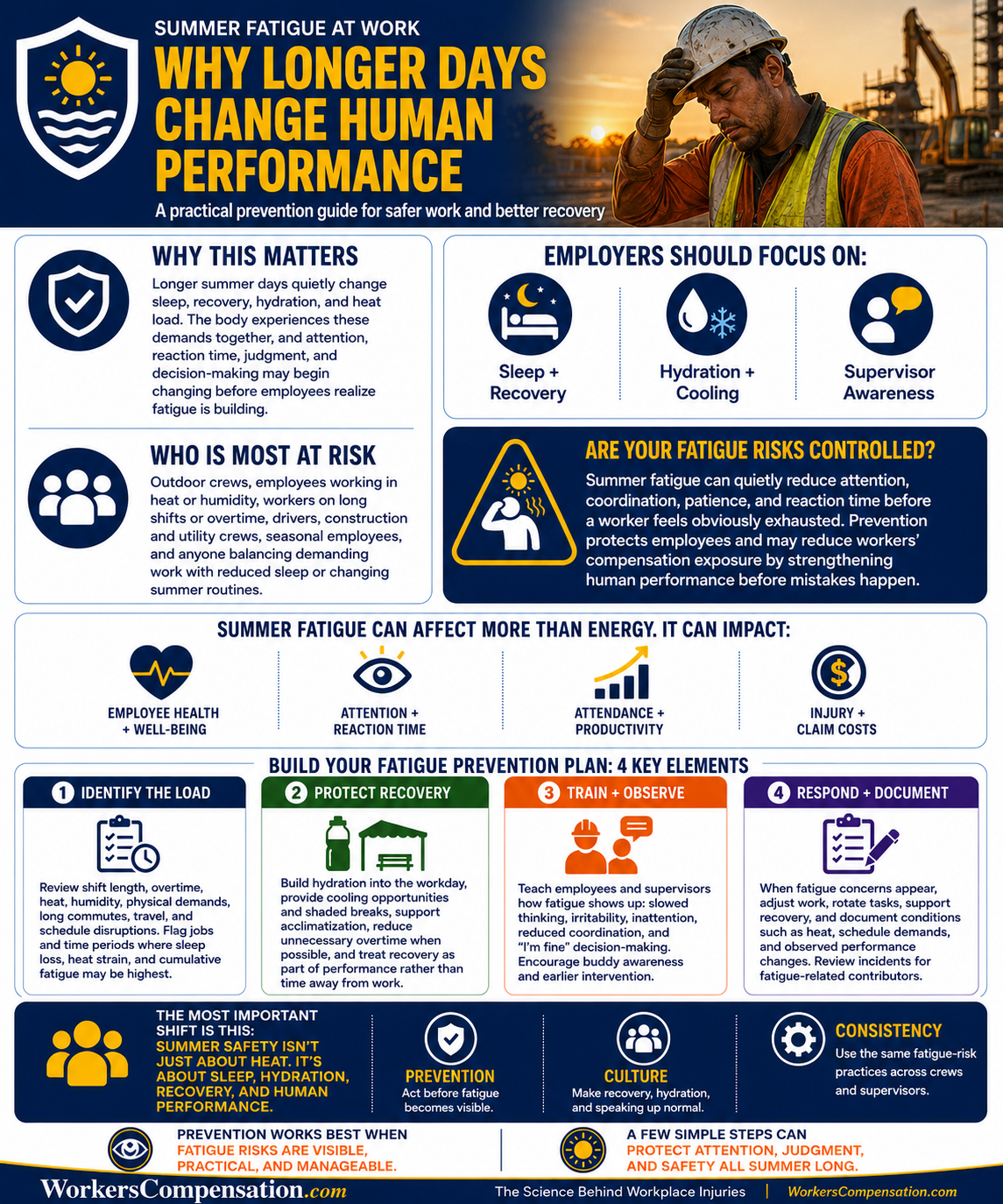
Have you ever reached the end of a summer workday feeling more mentally exhausted than the work itself seemed to justify? Summer changes daily life in subtle ways. The sun stays out later, evenings become busier. Vacations interrupt routines and children are home from school. Outdoor activities compete for sleep. Temperatures rise as humidity thickens. Most changes seem insignificant on their own and of course, human physiology experiences them differently. The body responds to cumulative demands rather than isolated events.
The brain constantly manages energy. Deep within the brain, the suprachiasmatic nucleus serves as the body's master clock, using light entering the eyes to regulate circadian rhythms. Morning light promotes wakefulness. Darkness stimulates melatonin production and prepares the body for sleep. Longer summer evenings delay that biological transition, often shortening sleep without people recognizing the change. Researchers studying seasonal circadian rhythms have shown longer daylight shifts both melatonin timing and sleep duration, altering recovery before the next workday even begins.
Sleep represents only one part of the equation. Heat places additional demands on the cardiovascular system. Mild dehydration reduces the efficiency of the brain. Physical work consumes energy throughout the day. Together, those physiological demands influence attention, reaction time, working memory, and decision-making. The body does not separate those challenges into individual categories. It experiences them as total physiological load.
The relationship between hydration and cognition has become remarkably clear. Wittbrodt and Millard-Stafford's 2018 meta-analysis found dehydration approaching two percent of body mass impaired attention, executive functioning, and motor coordination. Ganio, Armstrong, Casa, McDermott, Lee, Yamamoto, and colleagues demonstrated measurable declines in attention and concentration with body water losses of only 1.5 percent. Brain imaging studies add another fascinating layer. The dehydrated brain recruits additional activity within the prefrontal cortex to maintain performance, suggesting more effort is required to accomplish the same cognitive work. Physiology changes before performance visibly declines.
Sleep science reaches a similar conclusion. Dawson and Reid's landmark 1997 study demonstrated seventeen hours of sustained wakefulness produces psychomotor impairment comparable to a blood alcohol concentration of approximately 0.05 percent. Twenty-four hours awake approaches the legal intoxication threshold in many jurisdictions. Fatigue influences judgment in ways many people never recognize because the brain evaluating performance is experiencing the same fatigue affecting performance.
Researchers continue finding the effects inside the workplace. Uehli and coauthors' 2014 meta-analysis involving more than 268,000 workers found employees experiencing sleep problems faced a 62 percent higher risk of occupational injury. The investigators estimated approximately thirteen percent of workplace injuries could be attributed to sleep problems alone. Fatigue rarely appears as the diagnosis on an injury report. Its influence often appears underneath the diagnosis by altering attention, judgment, coordination, and reaction time before the incident occurs.
Heat adds another important dimension. Park and researchers at UCLA analyzed more than eleven million California workers' compensation claims and found injury rates increased as temperatures climbed, even when the injuries themselves were not diagnosed as heat illnesses. More recently, Dr. Barrak Alahmad and researchers from the Harvard T.H. Chan School of Public Health and George Washington University estimated approximately 28,000 occupational injuries during 2023 were attributable to heat exposure above 70 degrees Fahrenheit. The findings reinforce an important principle. Heat changes human performance long before heat illness appears.
Workers' compensation professionals frequently investigate the event immediately preceding an injury. Summer fatigue encourages a broader perspective. Sleep, heat, hydration, physical workload, changing routines, and cumulative physiological strain all influence how employees arrive at work each day. A single factor rarely explains why an injury occurred. Human performance reflects the interaction of many small physiological demands occurring simultaneously.
Leadership creates meaningful opportunities for prevention. NIOSH and OSHA recommend acclimatization for new and returning employees, structured hydration practices, scheduled recovery breaks, supervisor education, and fatigue risk management systems. The proposed federal Heat Injury and Illness Prevention Standard builds on many of those same concepts because the science has become increasingly consistent. Organizations strengthen safety by protecting recovery as intentionally as they protect production. Capacity grows through recovery, not continuous demand.
Summer fatigue reminds us people do not arrive at work with identical physiological capacity every morning. Biology reflects yesterday's sleep, today's temperature, hydration status, physical demands, and dozens of other influences that rarely appear on a schedule or production report. While this is not isolated to summer, it does compound with additional components during this time of year. Understanding those influences helps leaders design healthier workplaces and helps investigators ask better questions after injuries occur. Human performance is never determined by one factor. It reflects the physiology people bring with them each day.
Tomorrow in The Science Behind Workplace Injuries - The Psychology of “It Won’t Happen to Me.” Every employee understands workplace injuries happen. Far fewer believe they will happen to them. Tomorrow, we explore optimism bias, one of the most powerful psychological forces influencing workplace decision-making, and why good employees often underestimate their own risk.


AI california case file caselaw case management case management focus claims compensability compliance compliance corner courts covid do you know the rule employers exclusive remedy florida fraud glossary check Healthcare hr homeroom insurance insurers iowa kentucky leadership NCCI new jersey new york ohio pennsylvania Safety safety at work state info tech technology the case manager violence WDYT what do you think women's history women's history month workers' comp 101 workers' recovery Workplace Safety Workplace Violence
Read Also
- Sep 09, 2026
- Chris Parker
- Sep 09, 2026
- Claire Muselman
About The Author
About The Author
-
Claire Muselman
Meet Dr. Claire C. Muselman, the Chief Operating Officer at WorkersCompensation.com, where she blends her vast academic insight and professional innovation with a uniquely positive energy. As the President of DCM, Dr. Muselman is renowned for her dynamic approach that reshapes and energizes the workers' compensation industry. Dr. Muselman's academic credentials are as remarkable as her professional achievements. Holding a Doctor of Education in Organizational Leadership from Grand Canyon University, she specializes in employee engagement, human behavior, and the science of leadership. Her diverse background in educational leadership, public policy, political science, and dance epitomizes a multifaceted approach to leadership and learning. At Drake University, Dr. Muselman excels as an Assistant Professor of Practice and Co-Director of the Master of Science in Leadership Program. Her passion for teaching and commitment to innovative pedagogy demonstrate her dedication to cultivating future leaders in management, leadership, and business strategy. In the industry, Dr. Muselman actively contributes as an Ambassador for the Alliance of Women in Workers’ Compensation and plays key roles in organizations such as Kids Chance of Iowa, WorkCompBlitz, and the Claims and Litigation Management Alliance, underscoring her leadership and advocacy in workers’ compensation. A highly sought-after speaker, Dr. Muselman inspires professionals with her engaging talks on leadership, self-development, and risk management. Her philosophy of empathetic and emotionally intelligent leadership is at the heart of her message, encouraging innovation and progressive change in the industry. "Empowerment is key to progress. By nurturing today's professionals with empathy and intelligence, we're crafting tomorrow's leaders." - Dr. Claire C. Muselman
More by This Author
Read More
- Sep 09, 2026
- Chris Parker
- Sep 09, 2026
- Claire Muselman
- Sep 09, 2026
- Frank Ferreri
- Sep 09, 2026
- Chris Parker
- Sep 09, 2026
- Anne Llewellyn
- Sep 09, 2026
- Claire Muselman